


You're driving home after sunset, and the road itself isn't the problem. The problem is the lights. Headlights seem to explode into streaks. Streetlights look fuzzy and spiky. Road signs don't sharpen until you're closer than feels comfortable. If that sounds familiar, there's a good chance you're not dealing with “normal” night driving strain. You may be dealing with astigmatism that isn't being corrected precisely enough.
That matters because the fix usually isn't a gimmick product from a gas station shelf or an online ad for yellow lenses. For people with astigmatism, astigmatism glasses for night driving need to do one thing first: correct the actual refractive error. After that, the right lens design, the right anti-reflective coating, and the right fit make a major difference.
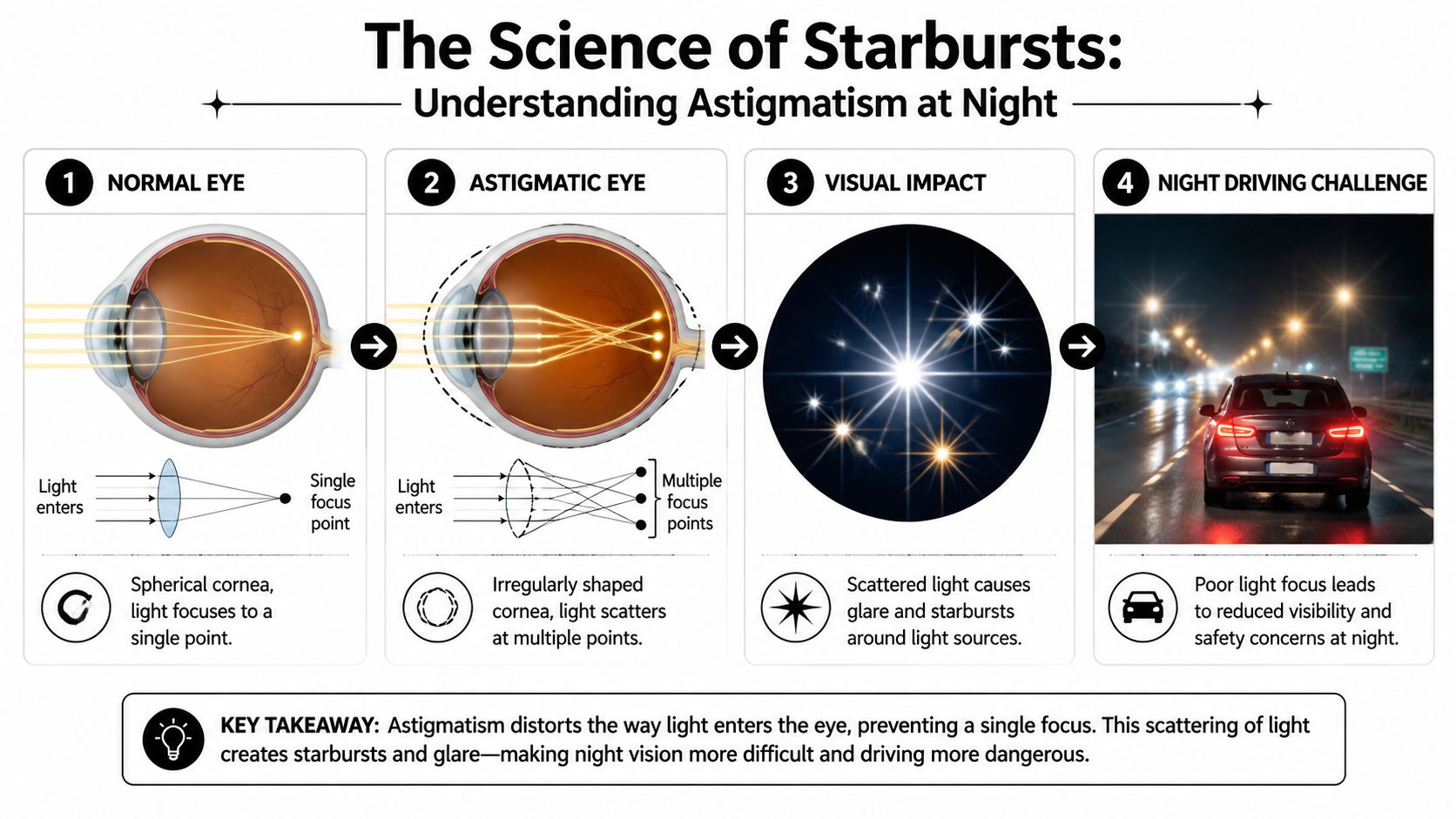
The Science of Starbursts Why Astigmatism Blurs Your Night Vision
Individuals often describe the symptom before they know the cause. They'll say, “Lights smear,” or “Everything has a halo,” or “I can see during the day, but night driving feels stressful.” Those descriptions are accurate. They're also classic signs of astigmatism.
Astigmatism changes how light focuses inside the eye. In a typical eye, the front surface of the eye is shaped more evenly, so incoming light focuses into a single point on the retina. With astigmatism, the corneal curvature is irregular, so light bends unevenly and lands in multiple focal points instead of one. That's why bright points of light don't stay as points.
Why headlights turn into streaks
A simple analogy helps. Think of a normal cornea like a basketball. It's evenly curved. Now think of an astigmatic cornea like a football. One curve is steeper than the other. Because of that uneven shape, the eye can't focus light cleanly.
At night, this becomes much more obvious. Headlights, traffic signals, and reflective signs create strong contrast against a dark background. If your eye is splitting that light into more than one focal point, the result is often starbursts, halos, and streaky glare rather than a crisp image.
What this means on the road
This isn't just about discomfort. It affects how clearly you judge space, contrast, and detail. A pedestrian in dark clothing, the edge of a lane, or a sign partially washed by glare can all become harder to interpret.
Common night-driving complaints from people with astigmatism include:
- Starbursts around headlights: Light appears to radiate outward in spikes.
- Halos around streetlights: A ring or glow forms around bright objects.
- Ghosting or double edges: A sign may look like it has a faint duplicate.
- Reduced contrast: Objects don't stand out from the background as well.
Astigmatism doesn't create “bad night vision” in a vague sense. It creates a specific optical focusing problem, and that's why the right correction can help.
Why non-prescription solutions miss the real issue
A tinted lens can dim what you see, but it can't reshape how your eye focuses light. Astigmatism is a refractive error. It needs a lens that matches your cylindrical power and axis so those multiple focal points are brought back into proper alignment.
That's why patients are often relieved to learn this problem is usually treatable. The blur is not random. It has a mechanical cause. And if you've ever wondered whether the condition itself can change over time, this guide on whether astigmatism can go away gives helpful background.

“If headlights look starry or streaky at night, an updated astigmatism correction often helps a lot. Bring it up at your exam so we check it carefully.”
A Precise Diagnosis Your First Step to Clearer Night Driving
Night-driving frustration often starts with an almost-correct prescription. That's the part many patients don't realize. You can see “well enough” in daylight and still struggle badly after dark if the astigmatism measurement is even slightly off.
A proper exam does more than tell you whether you need glasses. It identifies the exact shape of the correction your eyes need. In astigmatism, two parts of the prescription matter especially: Cylinder (CYL) and Axis. Cylinder tells us how much astigmatism is present. Axis tells us where that correction must be positioned.
Why exact numbers matter more at night
When the cylindrical correction or axis is off, the lens won't line up with the way your eye bends light. During the day, bright conditions may let you compensate a little. At night, that margin disappears. Glare, low contrast, and bright point light sources expose small prescription errors fast.
Clinical evidence supports how important precise correction is. A 2013 study in Optometry and Vision Science found that correcting even low to moderate astigmatism improved night-driving performance, with up to a 20% increase in contrast sensitivity, a 25% improvement in sign recognition distances, and 92% of participants reporting safer driving experiences.
What happens during the exam
A thorough evaluation for night-driving complaints usually includes more than reading letters off a chart. Your optometrist looks at how your eyes focus, how stable your prescription is, and whether the measured correction matches the symptoms you're describing.
Important parts of that process include:
- Refraction: This determines which lens power gives you the clearest image.
- Astigmatism measurement: This identifies the amount and orientation of the cylindrical correction.
- Corneal surface assessment: This helps confirm whether the front surface of the eye explains the visual distortion you're reporting.
- Prescription refinement: Small adjustments can matter a lot when headlights are your biggest complaint.
A lot of confusion comes from people assuming blur is blur. It isn't. Nearsightedness, dryness, early cataract changes, and astigmatism can all create different nighttime complaints. A careful eye exam and refraction test helps separate those causes so you're not guessing.
Practical rule: If night driving feels much worse than daytime driving, don't assume you just need “stronger glasses.” You may need a more accurate astigmatism correction.
Choosing Your Lenses Materials and Designs for Astigmatism
Once the prescription is right, the next question is what kind of lens should carry that prescription. Many people find this stage overwhelming. They hear terms like high-index, single vision, toric, aspheric, and assume they all mean the same thing. They don't.
For astigmatism, the physical lens matters because lens thickness, weight, and optical design affect comfort and clarity. The goal isn't just to make the lens look better. The goal is to make the correction more stable and easier to wear, especially if you drive often at night.
High-index lenses versus thicker standard lenses
Stronger astigmatism prescriptions often produce thicker lenses, especially at the edges. Thicker lenses can feel heavier and may create more noticeable peripheral distortion. That's why high-index spectacle lenses are often recommended for astigmatism. They can be made thinner and lighter, which helps reduce the optical aberrations that become more noticeable in thicker lenses.
Here's a simple comparison:
| Lens choice | Main advantage | Why it matters for astigmatism |
|---|---|---|
| Standard plastic lens | Familiar and widely used | May be fine for mild prescriptions |
| High-index lens | Thinner and lighter | Often more comfortable and can reduce distortion from bulkier lens edges |
| Toric contact lens | Corrects astigmatism directly on the eye | Can provide excellent vision if the lens stays properly aligned |
If your prescription includes astigmatism and you want a straightforward overview of how corrective lenses are built, this page on single vision lenses is a useful reference.
Why lens design affects what you notice at the edges
Two people can have the same prescription and feel very different wearing their glasses. Part of that comes down to lens design. A lens that's bulky or poorly matched to the frame can create odd edge awareness, magnification effects, or a “swim” feeling when you move your eyes.
Patients often notice this most when:
- Scanning intersections: You're shifting gaze quickly from center to side.
- Checking mirrors: Peripheral clarity matters more than people expect.
- Driving in rain at night: Visual noise is already higher, so distortions stand out.
An optician may also recommend a flatter, more refined lens profile for comfort and appearance. That doesn't replace the prescription itself, but it can improve how naturally the lenses feel in real life.
Toric contacts are an option, but alignment is everything
Some people prefer not to wear glasses while driving. Toric contact lenses can work very well for astigmatism because they're designed to correct the orientation-specific blur caused by the cornea's shape. The key is that they must remain stable on the eye.
If a toric lens rotates, the cylindrical correction rotates with it. Then the image can blur almost immediately. That's why patients sometimes say, “My vision is sharp for a moment, then it shifts.” In many cases, that's a lens stability issue rather than a power issue.
A toric lens isn't just a regular contact with a different name. It has to stay oriented correctly, or the correction stops matching your eye.
For drivers who split time between glasses, contacts, motorcycles, and other outdoor conditions, it also helps to think about protection beyond ordinary vision correction. Riders in particular may find this guide to protective eyewear for motorcycles in Florida useful because wind, debris, and glare can compound visual stress after dark.
The Anti-Glare Solution Why AR Coatings Are Non-Negotiable
If the prescription is the foundation, anti-reflective coating is the feature that many night drivers notice first once they start using it. In this context, marketing has created a lot of confusion. People hear “anti-glare” and think any lens that claims to reduce glare must help. That's not true.
For astigmatism, you need two separate things. First, you need the refractive error corrected. Second, you need to reduce reflections bouncing off the lens itself. A high-quality AR coating addresses that second problem directly.

What AR coating actually does
Every clear lens reflects some light. Without coating, that reflected light can bounce off the front and back lens surfaces and create extra visual noise. For someone with astigmatism, that's especially frustrating because your eyes are already struggling to focus point light sources cleanly.
A quality AR coating reduces surface reflectance on a lens from about 4% per lens surface to less than 0.5%, which is why it can make lenses look clearer and reduce internal glare. In plain terms, more useful light passes through the lens, and less stray reflection interferes with what you're trying to see.
Why yellow night-driving glasses are the wrong solution
This is the myth that needs to be challenged directly. Non-prescription yellow-tinted “night driving glasses” are marketed as though they solve glare. For people with astigmatism, they don't correct the core optical problem. Worse, the tint can reduce the amount of light reaching the eye.
A 2015 study summarized by All About Vision reported that non-prescription yellow-tinted night-driving glasses did not improve pedestrian detection at night, with 78% of participants showing no significant improvement. The same source notes the American Academy of Ophthalmology's warning that these lenses can reduce visual acuity by 15% to 20% in low-light conditions.
That point is easy to miss. A lens can feel “softer” or “less harsh” because it dims the scene. But dimmer isn't the same as clearer. If the lens reduces luminance without correcting astigmatism, you may feel more comfortable for a moment while seeing less detail.
Yellow tint may change how glare feels. It doesn't correct why astigmatism creates glare in the first place.
What to look for instead
For astigmatism glasses for night driving, ask for clear prescription lenses with a multi-layer AR coating. That combination addresses the actual refractive error and the lens-surface reflections that pile on top of it.
A useful way to think about the options:
Non-prescription yellow lenses
- May dim incoming light
- Don't correct cylindrical power or axis
- Can reduce low-light clarity
Prescription lenses without AR
- Correct the refractive error
- Still allow more distracting reflections off the lens surfaces
Prescription lenses with quality AR
- Correct the astigmatism
- Reduce lens reflections and ghosting
- Preserve a clear, untinted view for dark conditions
If you want a visual explanation of how anti-glare lens technology works in everyday use, this video is a helpful primer.
Why this feature deserves priority
Patients sometimes spend a lot of time choosing frame color and very little time discussing coating quality. For a frequent night driver with astigmatism, that's backwards. The coating won't replace the prescription, but it can make a noticeable difference in comfort and visual cleanliness.
If you're comparing options, it helps to review the basics of anti-glare coating for glasses so you know what questions to ask when a dispenser offers different AR tiers.
How Frames and Fit Impact Your Night Driving Safety
A strong prescription in the wrong frame won't perform the way it should. Glasses are not just lenses with arms attached. They're a positioning system. If the frame sits poorly, the optical center of the lens may not line up where your eyes look.
Its significance is often underestimated at night. When glare is already stressing the visual system, small misalignments can make lenses feel “off,” even when the prescription itself is correct.
Why frame shape changes the experience
Larger lens areas often give drivers a wider clear field of view. That can help when you're scanning side streets, checking mirrors, or picking up motion in the periphery. A frame that's too small or sits too low may force you to look through less optimal parts of the lens.
A few fit priorities matter most:
- Stable bridge fit: Keeps the lenses from sliding down and changing your viewing position.
- Correct pantoscopic tilt: Helps the lenses sit at the intended angle in front of your eyes.
- Good lens height and width: Supports better peripheral awareness while driving.
- Comfort behind the ears: Reduces the urge to constantly readjust the frame.
Why professional adjustment matters
People often assume that if glasses feel comfortable, they fit correctly. Comfort is part of it, but alignment is the bigger issue. The frame should hold the lenses so your pupils line up with the intended optical centers. If they don't, you may notice blur, strain, or odd distortion when glancing off-center.
A frame guide can help you understand sizing terms before you shop. This overview of eyeglass frame sizes explains how width, bridge, and lens dimensions affect both fit and function.
The best night-driving glasses don't work as isolated lenses. They work as a calibrated system: prescription, lens design, coating, frame, and fit.
More Than Glasses Proactive Driving Habits for Better Night Vision
Good eyewear helps. Good driving habits help too. If you have astigmatism, small environmental fixes can lower the amount of visual noise your eyes have to process at night.

Habits that reduce glare without buying anything
Start with the car itself. A dirty windshield scatters light. So do smudged mirrors and dusty headlight covers. Even a perfect pair of glasses can't fully overcome light scatter created by grime.
Use this checklist before regular night driving:
- Clean the windshield inside and out: Interior film is a common source of haze and glare.
- Wipe mirrors and glasses lenses: Smears create additional light scatter.
- Dim dashboard brightness: A bright cabin makes the outside road feel darker by comparison.
- Avoid staring into oncoming headlights: Shift your gaze slightly toward the right edge of your lane when needed.
- Give yourself more time: Night driving is less forgiving, so extra following distance helps.
Building confidence behind the wheel
Many drivers with astigmatism also become anxious because they don't trust what they're seeing. That anxiety is understandable. Better habits can reduce stress while you're getting your prescription sorted out or adapting to new lenses.
If you want structured practice, especially after avoiding night driving for a while, Skillz2Drive night driving courses show the kind of guided training that can help drivers rebuild comfort in low-light conditions.
And if you're due for any official vision paperwork or want to make sure your visual status is up to date, an eye exam for driver's license renewal can be a practical step.
Consult with Style Site Optical in Aventura
If night driving has started to feel tense, the answer usually isn't to avoid the road forever or keep trying random products. It's to get specific. You need to know whether your astigmatism prescription is current, whether your lens design matches your prescription, and whether your glasses include the features that are helpful after dark.
That's where an experienced optometrist makes the difference. You want someone who will listen carefully to how you describe the problem. “Headlights look spiky” and “signs stay blurry too long” are clinically useful details. They help guide the exam and the lens recommendations.

Questions worth asking during your visit
A productive appointment often starts with good questions. Bring these with you if you're choosing astigmatism glasses for night driving:
- Is my cylinder and axis prescription still accurate for nighttime symptoms?
- Would a high-index lens make this prescription more comfortable or clearer?
- Am I a good candidate for toric contact lenses, or are glasses the better night-driving option?
- Which anti-reflective coating do you recommend for frequent night driving?
- Is my current frame size limiting how well my lenses perform?
- Are any other eye conditions contributing to my glare symptoms?
Why local expertise matters
For patients in Aventura, Miami, Hollywood, and North Miami Beach, it helps to work with a practice that combines medical accuracy with careful eyewear selection. A rushed refraction and a generic pair of lenses can leave you thinking “glasses don't help me at night,” when the underlying issue is that the correction wasn't precise enough or the final pair wasn't optimized.
Style Site Optical serves South Florida patients who want that more detailed approach. Dr. Bollar and the team provide thorough exams, advanced diagnostic testing, and guidance on lens materials, coatings, and frame choices suited for real-world use. If you'd like to learn more about the practice and its providers, visit the eye specialists in Aventura.
Clearer night driving usually doesn't come from one magic product. It comes from getting the prescription right and then building the right pair of glasses around it.
If night driving has become frustrating or stressful, Style Site Optical can help you take the next step with a precise eye exam, expert guidance from Dr. Bollar, and eyewear recommendations designed for astigmatism and low-light driving.

Medically reviewed by Dr. Teresita Bollar, OD, Optometrist at Style Site Optical, Aventura, FL.


