You’re probably here because some part of your vision doesn’t feel quite right. Maybe road signs look soft at night, small print keeps drifting out of focus, or you’re due for an eye exam and want to know what that “better one or two?” part is doing.
That part of the exam is the eye exam refraction test. It’s one of the most familiar parts of a visit to the eye doctor, and also one of the most misunderstood. Patients often assume it’s just a quick glasses check. In reality, it’s the process that helps your optometrist figure out the exact lens power that gives you the clearest, most comfortable vision possible.
A good refraction test doesn’t feel like a machine deciding for you. It feels like a conversation. Your doctor gathers measurements, shows you lens choices, listens to your answers, and fine-tunes the result until your prescription matches how you see in daily life.
Last updated: August 2026
An Introduction to the Refraction Test
If you’ve ever looked through a big mask-like device and heard, “Which is better, one or two?”, you’ve already experienced the core of a refraction test.
The refraction test is the part of an eye exam that determines whether you need glasses or contact lenses, and if you do, what prescription you need. It measures how light bends as it passes through your eye so your doctor can correct blur caused by common focusing problems.
Many people confuse refraction with the health portion of the exam. They’re related, but they’re not the same. A full eye exam checks how well you see and also looks at the health of the eye itself. That includes concerns involving the retina, optic nerve, and other internal structures, which is why tests such as retinal imaging can be part of a full visit.
What the test is really asking
The refraction process is trying to answer a practical question. What lens power gives you your best, most comfortable vision?
That’s why your answers matter so much. You’re not being tested. You’re helping guide the result.
Here’s the simplest way to understand it:
- If things are blurry far away, your eyes may need help focusing distance.
- If close work feels strained, you may need help at near.
- If vision seems shadowed or stretched, astigmatism may be part of the picture.
- If your vision changes depending on lighting or fatigue, your doctor may need to refine carefully for comfort, not just sharpness.
A refraction test works best when doctor, technology, and patient responses all line up.
The process is straightforward, painless, and usually much easier than people expect. Once you understand what each step means, the whole experience feels less mysterious and far more useful.
Why a Refraction Test Is Crucial for Your Vision
Approximately 43% of visual impairments worldwide are caused by refractive errors, which is why refraction is such an important part of eye care, according to this overview of the eye refraction test.

That matters because refractive errors are usually correctable. In plain terms, your eye is trying to focus light, but the light isn’t landing where it should. When that happens, the image you see looks blurred, strained, doubled, or less crisp than it should.
Think of your eye like a camera
A camera needs the lens to focus light onto the sensor. Your eye needs to focus light onto the retina. If the focus point is off, the picture won’t be sharp.
The main refractive errors are common:
- Myopia means distant objects look blurry.
- Hyperopia means near tasks may be difficult or tiring.
- Astigmatism means the focus is uneven, which can make vision look smeared or distorted.
- Presbyopia is the age-related loss of near focusing that often becomes noticeable after age 40.
These aren’t signs that you’ve done something wrong. They’re focusing issues, and the refraction test is how your doctor measures them.
Why symptoms can be confusing
Patients don’t always walk in saying, “I think I have a refractive error.” More often they say things like:
- “I can see, but it’s not sharp.”
- “I get headaches after screens or reading.”
- “Night driving is harder than it used to be.”
- “I keep taking my glasses on and off.”
Those are real-world clues that your focusing system may need adjustment.
A refraction test turns those vague experiences into something specific. It tells your doctor whether blur is coming from a lens-power issue, and it also helps separate that from problems that need a medical eye health evaluation. That distinction is especially important for patients with broader health concerns, including people who need diabetes and hypertension eye care.
Clear vision and healthy eyes are not the same thing. A person can need a prescription update, an eye health workup, or both.
When patients understand that difference, the exam starts to make much more sense.
The Two Halves of Your Refraction Test
Most patients think the test starts when they answer “one” or “two.” It starts earlier.
A modern eye exam refraction test has two connected parts. One gathers the starting measurement. The other refines it based on how you see.

Objective refraction
The first half is objective refraction. This uses instruments such as an autorefractor to estimate your prescription without needing your verbal input.
According to this explanation of the refraction process, objective refraction provides a patient-independent starting point by measuring how light reflects from the retina. That gives your doctor a useful baseline before the fine-tuning begins.
This part is helpful because it answers a basic question. What does the eye seem to need, before the patient starts choosing lenses?
Patients often like this part because it feels quick and uncomplicated. You look at a target, the device takes a reading, and your doctor gets a starting map.
Subjective refraction
The second half is subjective refraction. This is the part people remember.
You look through a phoropter while your doctor switches lenses and asks which option is clearer. Your responses help refine that initial estimate until the prescription matches your sharpest and most comfortable vision.
At this stage, the test becomes collaborative. A machine can estimate. Only you can say what feels clearer.
Why both parts matter
Neither half replaces the other.
Objective testing is useful because it starts with measurement. Subjective testing is useful because it finishes with experience. Together, they help your doctor work toward best-corrected visual acuity, often called BCVA.
A simple comparison helps:
| Part | What it does | Who leads it |
|---|---|---|
| Objective refraction | Estimates your refractive error with instruments | The device and doctor |
| Subjective refraction | Refines the estimate using lens choices | You and the doctor |
Clinical insight: The most accurate prescription usually comes from combining technology with patient feedback, not choosing one over the other.
This is also why your answers don’t need to be perfect. If two choices look almost the same, say so. If one feels sharper but less comfortable, mention that too. Those details help your optometrist build a prescription you can live with, not just one that looks good on paper.
What to Expect During the Refraction Process
When you sit down for the refraction portion of the exam, the room usually feels dimmer than a normal office. That’s deliberate. It helps reduce visual distractions and makes the eye chart easier to see.

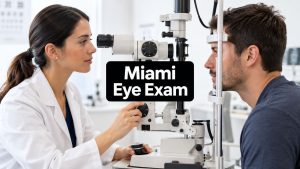
You’ll either start with an automated reading or move straight into the chair with the phoropter, which is that large instrument with multiple lenses in it. It may look bulky, but it’s a very precise way to place different lens powers in front of your eyes.
If you need a same-day or flexible visit, some practices also make this process easier to access through a walk-in eye exam.
The eye chart and the 20-foot standard
The standard setup uses a Snellen eye chart positioned at 20 feet, and 20/20 means you can read letters about 3/8 of an inch tall from that distance, as explained in this patient guide to understanding a refraction test. The same source notes that the test is painless and typically takes only a few minutes.
That 20-foot standard gives your doctor a consistent way to measure how clearly you see. It’s not an arbitrary number. It creates a reliable benchmark.
What the doctor is doing during all those clicks
As your doctor rotates lenses in the phoropter, each click changes the focusing power in front of your eye. You’ll be asked to compare options that may look very different, or nearly identical.
That’s normal.
Some questions are about sharpness. Others are about comfort, balance, or whether letters look darker and cleaner. If your answers seem repetitive, it’s because small adjustments can matter.
Here’s what you can expect your doctor to assess during the process:
- Distance clarity for signs, screens, and driving
- Astigmatism refinement if letters look stretched, shadowed, or doubled
- Balance between the two eyes so one eye doesn’t do all the work
- Near demands if reading, phone use, or computer work is part of your concern
A short demonstration can make the process feel more familiar:
What if you’re not sure which lens is better
That’s one of the most common worries, and it doesn’t mean you’re “bad” at the test.
Try answers like these:
- “One is clearer.”
- “Two is darker but not sharper.”
- “They look the same.”
- “This one is sharp, but it feels strained.”
Those responses are useful. Your doctor isn’t looking for perfect certainty every time. They’re looking for patterns that guide the prescription.
If both choices look similar, saying so is better than guessing. Honest feedback produces a better result than forced answers.
Once patients know that, they usually relax. And when you relax, the test tends to go better.
From Test Results to a Perfect Prescription
After the refraction is finished, your results are translated into an eyeglass or contact lens prescription. This is the part many patients find mysterious because the printout looks like shorthand.
It’s more readable than it seems. The prescription is just a compact way to describe how much focusing help each eye needs.
The phoropter lets doctors refine Sphere and Cylinder in 0.25 diopter steps, and for patients over 40, a separate Add power may be determined for presbyopia, according to this refraction reference.
Understanding Your Eyeglass Prescription
| Abbreviation | Term | What It Means |
|---|---|---|
| OD | Oculus Dexter | Your right eye |
| OS | Oculus Sinister | Your left eye |
| SPH | Sphere | The main lens power for nearsightedness or farsightedness |
| CYL | Cylinder | The amount of astigmatism correction |
| Axis | Axis | The orientation of the astigmatism correction |
| ADD | Add | Extra near power for reading, often used for presbyopia |
How to read the plus and minus signs
The signs matter.
- A minus sign in SPH usually means nearsightedness correction.
- A plus sign in SPH usually means farsightedness correction.
- CYL shows that astigmatism correction is part of the prescription.
- Axis tells the lab where that astigmatism correction should be positioned.
- ADD is extra help for near work, often for bifocals, progressives, or multifocal contacts.
Here’s a simple example. If someone’s prescription includes a minus sphere value and a cylinder value, that person may be nearsighted with astigmatism. If an Add is included, they may also need near support for reading.
Why your prescription is only part of the solution
A prescription tells us the lens power. It doesn’t automatically decide the best lens material, coating, frame fit, or contact lens type.
That’s why lens selection still matters after the eye exam refraction test is done. For patients considering contacts, a separate fitting can determine which lens design matches the prescription and the eye surface most effectively. If that’s relevant for you, a contact lens fitting is the next step.
The prescription is the map. Glasses or contacts are the finished vehicle.
Once you know what the abbreviations mean, the paper in your hand stops looking like code. It becomes a practical description of how your eyes focus.
Why Isn’t a Refraction Test Covered by Insurance?
Because insurers classify refraction as routine vision care rather than medical care, it is usually billed as a separate line item — typically $15 to $50 — even when the rest of your exam is covered. Medicare specifically excludes eye examinations performed to prescribe or change eyeglasses, so it does not pay for refraction at all.
- Vision plans (VSP, EyeMed and similar) generally do cover refraction as part of a routine exam; medical plans generally do not.
- If your visit is billed to medical insurance for a condition like dry eye or diabetes, the refraction portion is normally your responsibility.
- You should be told about a non-covered charge before the exam, not after — ask at check-in and we will tell you exactly what to expect.
How Much Does a Refraction Test Cost?
Most practices charge $15 to $50 for refraction when it is not covered. At our Aventura office it is included in the $140 comprehensive eye exam, so there is no separate refraction fee to be surprised by.
Answering Your Top Questions About Refraction
Patients tend to ask the same practical questions, and they’re good ones. Most aren’t about the optics. They’re about comfort, kids, timing, and cost.

Is the refraction test painful
No. The refraction test is painless.
You’ll look at letters or symbols, answer comparison questions, and sit while lenses are switched in front of your eyes. Some people feel temporary visual fatigue if they’ve had a long day or if their prescription is changing, but the test itself doesn’t hurt.
How is refraction different for children
Children can absolutely have refraction testing, but the method may be adjusted to match their age and attention span.
A child who can’t read letters may use picture-based or symbol charts. Younger children may need shorter testing windows, simpler instructions, and a more play-based approach. The doctor may also adapt the pace depending on whether the child is shy, distracted, or eager to answer too quickly.
That matters because pediatric refraction isn’t just a smaller version of an adult exam. It often requires more flexibility, more observation, and clearer communication with parents.
Here are a few ways pediatric visits may differ:
- Chart choice changes if a child doesn’t know letters yet
- Instructions get simpler so the child can respond with confidence
- The pace may be faster to match a shorter attention span
- Doctor observation matters more when responses are inconsistent
Why is refraction sometimes billed separately
This is one of the biggest points of confusion.
A refraction test is often categorized by insurance plans as vision care rather than medical care, which can affect whether it’s covered. It’s smart to review your specific plan before the visit, especially if you’re trying to estimate out-of-pocket costs.
That separate billing doesn’t mean the test is optional or unimportant. It reflects how some insurers classify the service, not how useful it is clinically.
Practical rule: Call your insurer before your appointment and ask whether refraction is covered under your vision benefits, your medical benefits, or neither.
How often do I need one
That depends on your symptoms, age, and whether your vision feels stable. If your glasses no longer feel right, your screen work has changed, or reading is getting harder, it’s worth scheduling an exam.
For children, timing often depends on school demands, developmental stage, and whether parents or teachers have noticed signs of strain. For adults, changes in driving, reading, or digital work are common reasons to recheck the prescription.
What if my vision still isn’t crisp after refraction
That’s an important question. A refraction test measures lens power, but not every visual complaint comes from a standard prescription issue.
If vision still feels off after careful refraction, your doctor may look more closely at eye health, the tear film, binocular coordination, lens design, or whether a contact lens or glasses fit issue is part of the problem. That’s why a full exam matters.
Experience Advanced Refraction in South Florida
A refraction test may seem simple from the patient side. Read the chart, compare lenses, pick the clearer image. But the quality of the result depends on careful measurement, clinical judgment, and how well the doctor connects the numbers to your daily life.
That’s especially true when your needs aren’t basic. Maybe you switch between driving and screens all day. Maybe your child needs age-appropriate testing. Maybe you’re dealing with new near blur and want to understand whether it’s presbyopia, eye strain, or both.
In South Florida, practices vary in how they approach this part of the exam. One local option is refraction testing in Aventura, where patients can have refractive error measured as part of a full eye exam and discuss eyewear or contact lens options based on the results.
The best refraction experience doesn’t just hand you numbers. It connects those numbers to clear driving vision, easier reading, more comfortable screen time, and eyewear that suits how you live.
If you’ve been putting off an exam because the process felt confusing, this is the key point to remember. The eye exam refraction test is not a trick, not a quiz, and not something you can fail. It’s a guided process designed to help you see better.
If you’re ready to update your prescription, ask questions about insurance, or schedule an exam for yourself or your child, contact Style Site Optical. Their team provides complete eye care, refraction testing, and personalized guidance on glasses and contact lenses for patients in Aventura and the surrounding South Florida communities.

Medically reviewed by Dr. Teresita Bollar, OD, Optometrist at Style Site Optical, Aventura, FL.