
You’ve picked up your new glasses, put them on, and waited for the promised “high-definition” view. The center looks crisp, but the edges still feel unfamiliar, headlights remain distracting, or your progressive corridor seems harder to find than expected. That experience is common because lens technology alone doesn’t determine the result. The prescription, frame, measurements, lens design, and your daily visual habits all have to work together.
High definition lenses can improve how comfortably and clearly you see, especially when your prescription, frame position, and visual demands call for more precise optical design. They’re not automatically the right choice for every wearer, though. The most useful question isn’t “Are HD lenses better?” It’s “What problem are they being designed to solve, and were the right details measured?”
What High Definition Lenses Actually Mean
A 48-year-old graphic designer once came to an appointment after upgrading to HD lenses. He expected a television-like picture everywhere he looked. Instead, the change he noticed most was less dramatic but more useful: objects and text stayed clearer as he looked toward the sides of his lenses.
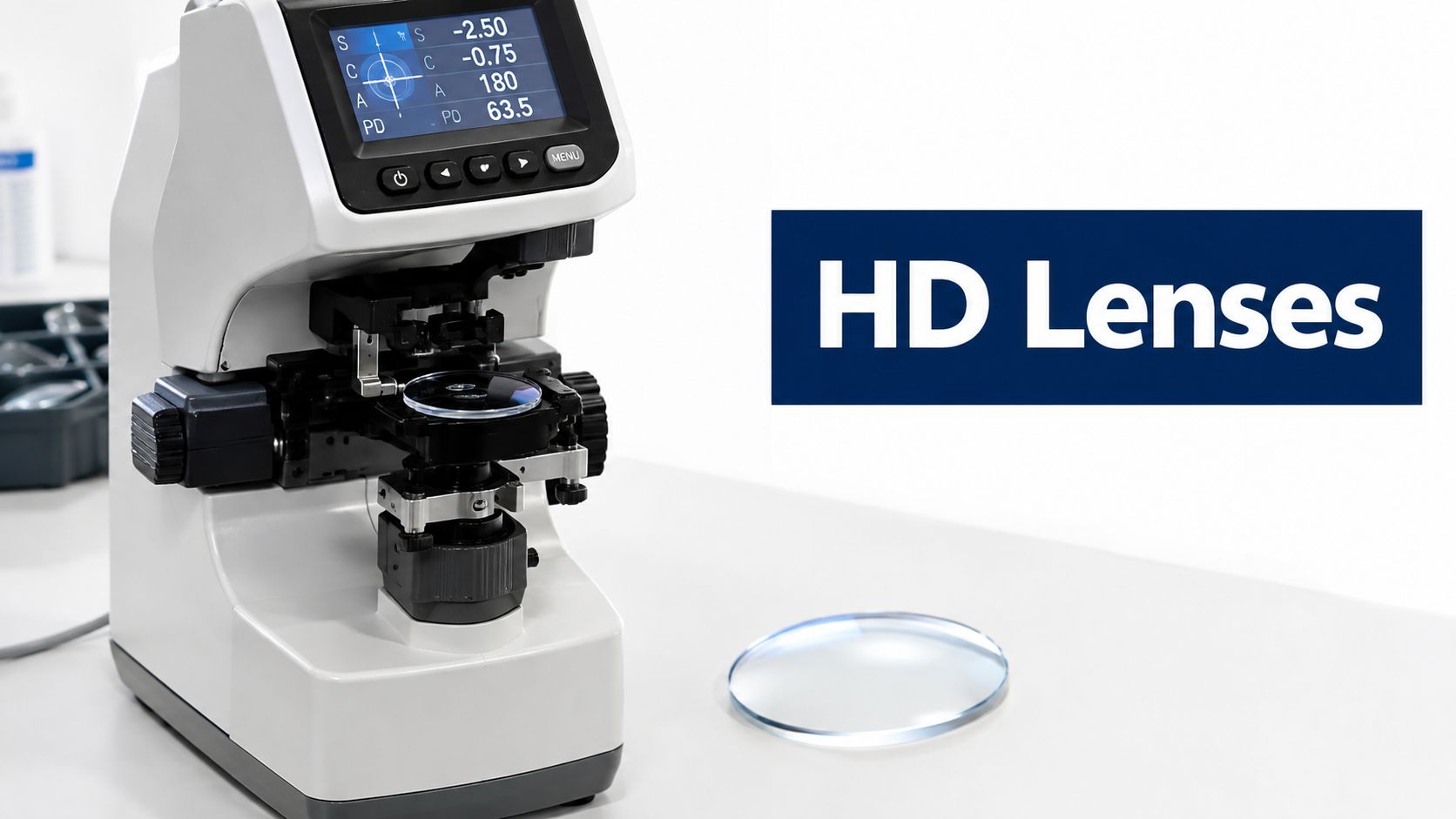
That distinction matters. High definition lenses are prescription lenses made with computer-controlled digital or free-form surfacing. Rather than applying one general curve across the lens, the manufacturing process can vary the surface point by point to reflect the wearer’s prescription, the frame’s position, and the way the eyes look through the lens.
A conventional lens uses a more uniform geometry. It corrects the main prescription effectively, but the design assumes a relatively fixed viewing position. As your gaze moves away from the central optical area, the lens can introduce blur, distortion, or unwanted image movement. This is especially noticeable in strong prescriptions, progressive lenses, large frames, or frames with significant curvature.
The problem HD design addresses
Your prescription usually corrects the familiar lower-order errors, such as nearsightedness, farsightedness, and astigmatism. It doesn’t automatically remove every optical imperfection created by lens shape and viewing angle. Peripheral blur can arise from spherical and cylindrical aberrations, along with more complex higher-order effects.
Free-form surfacing gives the designer more control over those effects. The lens can be calculated around your actual line of sight instead of relying only on a generic lens form.
ZEISS describes i.Scription® as a commercial milestone because it combined subjective refraction with wavefront measurement for eyeglass lenses, moving lens design beyond simple sphere-and-cylinder correction toward higher-order aberration measurement and compensation. Its optical history also identifies anti-reflective coating as an important enabling invention in 1935, showing how current lens designs build on a long period of optical engineering progress (historical overview of high-definition objective lens technology).
Practical rule: “HD” describes a design and manufacturing approach, not a guarantee that every wearer will notice the same improvement.
The term also covers several related technologies, including free-form lenses, digitally surfaced lenses, digital backside designs, and wavefront-informed optics. If you’re comparing products, ask what the label means in that specific package. A useful explanation of how branded digital lens designs fit into this category is available in this overview of Shamir optical lenses.
The Optics Behind Sharper Vision
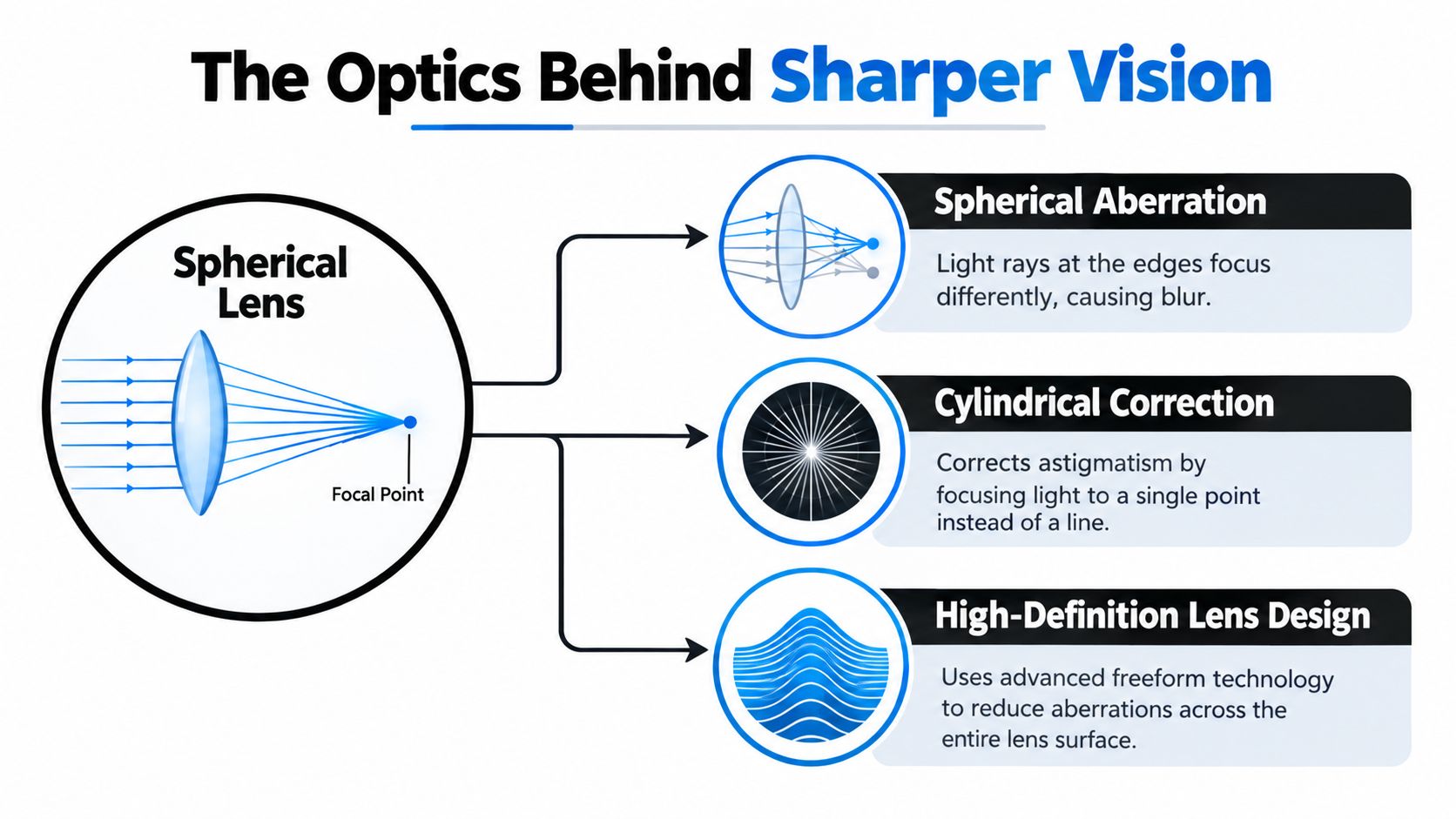
Start with the simplest corrective lens. A spherical lens bends incoming light toward a focal point. If you’re nearsighted, farsighted, or presbyopic, changing the lens power changes where that light focuses so the retina can receive a clearer image.
Astigmatism adds another layer. A cylindrical correction bends light differently in different meridians of the lens. Without that correction, light may focus in a line or in different locations rather than forming one clean image. Sphere and cylinder correction handle the most familiar prescription errors, but they don’t describe every way light can become distorted.
Why the edges can look different
A simple analogy is a magnifying glass. The center may show a crisp detail, while the outer portion produces more blur or bending. A spectacle lens can behave similarly, especially when you look through it away from its intended optical center.
These effects are called aberrations. Spherical aberration occurs when rays passing through different parts of a curved lens don’t focus in exactly the same way. Coma, trefoil, and other higher-order aberrations can create more complicated blur patterns. They may show up as reduced contrast, ghosting, glare, or image softness rather than a simple inability to read a letter chart.
Where wavefront data fits
Wavefront technology measures how light travels through the eye’s optical system. Instruments can analyze the way light passes through the cornea, internal lens, and pupil, producing an individualized pattern of optical irregularities.
That pattern is sometimes compared with a fingerprint. It isn’t a replacement for a standard refraction. Your measured sphere, cylinder, axis, and near prescription still form the foundation of the eyeglass prescription. Wavefront information can refine the design when the patient’s visual complaints or optical profile justify it.
Digital surfacing then translates the calculation into a changing lens geometry. Instead of relying on one mold that produces many identical lens forms, the computer-controlled process can vary the surface across many small zones to target the intended viewing paths.
The benefit depends on execution. An independent explanation of aspheric lens testing notes that image quality can be evaluated with modulation transfer function, or MTF, across wavelengths and viewing angles. Research on tunable aspherical lenses found performance approaching the diffraction limit at an optimized focal length of 7.6 mm, with MTF falling as the lens moved away from that optimum (aspheric lens principles and MTF evaluation).
That finding translates into a practical point: a surface can’t overcome poor positioning. A free-form design has to match how the lens sits in front of your eyes.
For a closer look at a specific branded approach, you can review this ZEISS digital lenses review.
Comparing HD Lenses to Standard and Premium Options
HD is often discussed as though it were a material, but it isn’t. HD refers primarily to how the lens is calculated and surfaced. Material, shape, and coating are separate decisions.
A standard spherical lens may be a sensible choice for a mild prescription and a small, relatively flat frame. An aspheric lens changes the lens profile to improve appearance and manage some off-axis effects. High-index material targets thickness and weight. Anti-reflective treatment manages surface reflections. Free-form surfacing targets more precise optical performance.
| Lens Type | Optical Performance | Thickness & Weight | Cost Tier | Best Suited For |
|---|---|---|---|---|
| Standard spherical | Corrects the basic prescription, with a more limited central sweet spot | Depends on material and prescription | Lower | Mild prescriptions and straightforward single-vision wear |
| Aspheric | Reduces some off-axis distortion and can improve cosmetic appearance | Often flatter and less magnifying than a basic spherical form | Moderate | Farsighted prescriptions, appearance-conscious wearers, and moderate prescriptions |
| High-index | Does not automatically sharpen the image, but can support a thinner lens | Designed for reduced thickness and weight in stronger prescriptions | Moderate to premium | Strong prescriptions where lens profile matters |
| Anti-reflective-coated | Reduces reflections and glare, while leaving the underlying lens geometry unchanged | Coating doesn’t materially determine lens thickness | Moderate to premium | Night driving, screen use, and anyone bothered by reflections |
| HD or free-form | Uses point-by-point digital calculations to optimize viewing zones and manage off-axis blur | Can be combined with high-index and aspheric materials | Premium | Progressive wearers, complex prescriptions, and demanding visual routines |
The strongest package often layers several elements: HD surfacing, an appropriate material, suitable geometry, and anti-reflective treatment. That combination also explains why a premium quote can rise. You’re paying for multiple optical decisions, not one magic ingredient.
Thin doesn’t mean optically sharper
High-index materials have a trade-off. As refractive index rises, surface reflectance also rises. One optics reference reports approximately 8% reflection for CR-39, about 10% for 1.60 index, and about 12% for 1.67 index materials, while another review states that AR coatings can reduce reflections to under 1% per surface and increase transmission to 99% or more (high-index lens reflectance and AR treatment).
That’s why a high-index lens should generally be paired with effective AR treatment. The material may make the lens thinner, but the coating helps preserve transmission, contrast, and cosmetic clarity.
You can explore the material side separately in this guide to high-index lenses. The key is to avoid treating HD, high-index, aspheric, and AR as interchangeable terms. They solve different problems.
Real Benefits and Honest Trade-Offs
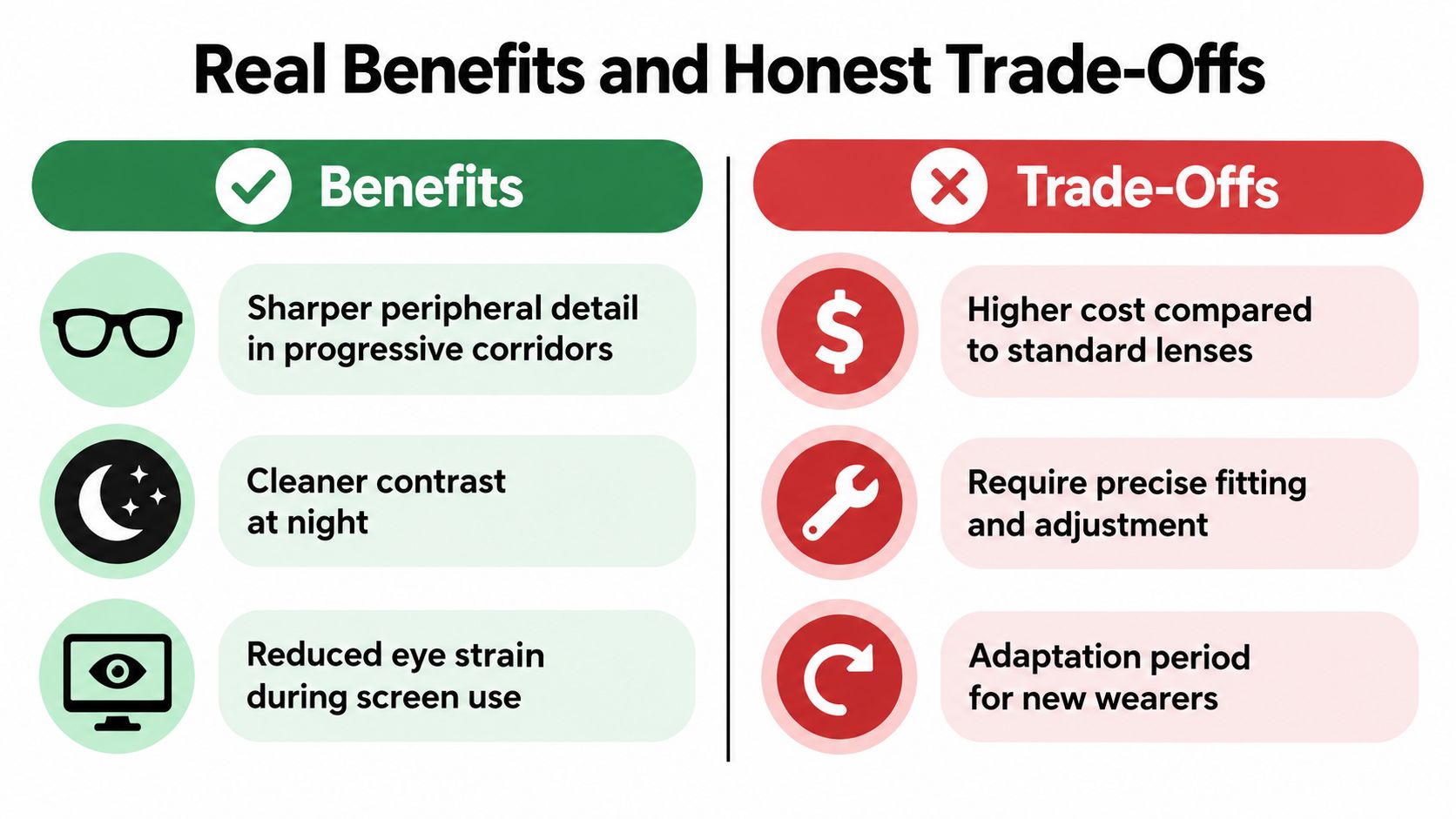
A progressive wearer may notice that detail remains easier to use toward the sides of the corridor. A driver after sunset may find reflections less distracting when the lens design and AR treatment suit the prescription. For someone working at a monitor, comfort can improve when the intermediate zone is calculated around the actual working distance. See this guide to the best lenses for computer work for related screen-use considerations.
These benefits are practical rather than guaranteed. Prescription strength, frame shape, measurements, lens design, and adaptation all affect the result. Industry coverage describes digital lens customization around prescription, frame shape, facial anatomy, and lifestyle, while also acknowledging that real-world outcomes are not always quantified clearly (discussion of digital lens customization and eyewear trends). That makes the fitting process as important as the label on the package.
Where the upgrade can earn its place
HD designs have more opportunity to show a difference when you use several parts of the lens throughout the day. Progressive wearers, people with strong prescriptions, long-term screen users, and night drivers may notice changes in peripheral control, contrast, or ease of use.
The upgrade can also make sense after glasses have produced persistent complaints despite an accurate prescription. Examples include swim, edge blur, trouble finding the near zone, or discomfort while shifting between viewing distances. In these cases, the issue may involve how the lens was designed or fitted, not the prescription power.
The trade-offs deserve equal attention:
- Cost: Premium packages cost more than basic designs. The final price depends on the material, coating, prescription, and frame.
- Adaptation: A new progressive geometry may still require adjustment, even when the lens is well made.
- Fitting sensitivity: Small errors in centration, height, or frame position can reduce the benefit of a carefully calculated surface.
- Limited payoff for some wearers: A mild single-vision prescription may provide fewer situations in which an advanced design is noticeable.
Thinner high-index material can introduce more chromatic aberration when the material and design are poorly matched. AR treatment can reduce reflections and support the visual performance of a good lens, but it can’t substitute for appropriate free-form geometry.
For a visual explanation of these trade-offs, watch the following overview:
The right upgrade addresses a complaint you actually have. It should not be presented as a universal improvement that every patient experiences equally.
Fitting and Prescription Considerations That Matter
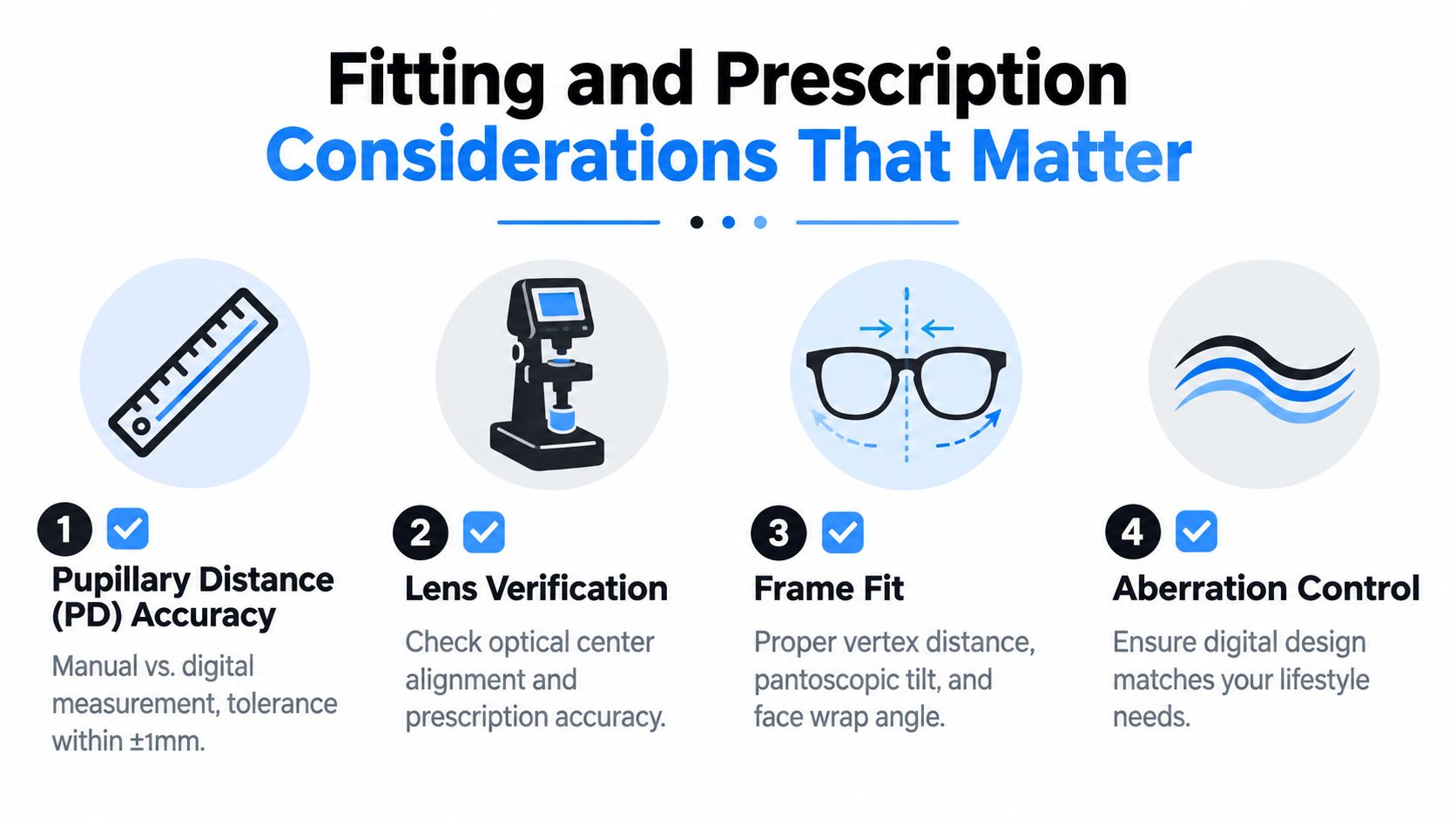
A digitally surfaced lens can be calculated with impressive precision, but the calculation depends on accurate inputs. The dispensing measurements determine where the lens sits relative to your pupils and how its optical zones meet your natural gaze.
Four measurements worth discussing
Pupillary distance affects horizontal centration. A small error can shift the intended optical path, especially in stronger prescriptions or customized designs. Ask whether your PD was measured monocularly, meaning separately for each eye, rather than assumed to be symmetrical.
Fitting height becomes particularly important in progressives. The measurement determines where the distance, intermediate, and near zones begin in relation to your pupils. If the height is wrong, you may search for the correct zone or experience unnecessary swim.
Frame position includes vertex distance, pantoscopic tilt, and face-form wrap. A frame that sits closer, lower, higher, or at a different angle than the design assumed changes the way you look through the lens.
Working distance shapes the design recommendation. A monitor placed at 60 cm creates a different visual demand from one placed at 80 cm, so tell the optician where your screen sits instead of accepting a generic computer prescription.
Frame choice can make or break the result
A steeply curved frame, high astigmatism correction, or wrap design may require specialized calculations. The lens has to account for the angle and position created by the frame, not just the numbers written on the prescription.
Bring a short checklist to your appointment:
- Prescription history: Mention changes in prescription, current symptoms, and whether you’re using single-vision or progressive lenses.
- Visual tasks: Describe reading, driving, screens, hobbies, and the distances you use most.
- Frame preferences: Share whether you want a curved, oversized, narrow, or lightweight frame.
- Past complaints: Bring your current glasses and explain exactly what feels wrong, such as glare, blur, headaches, or difficulty finding the near area.
Ask for verification: After the glasses arrive, the optician should check the prescription, optical centers, fitting height, and frame adjustment. Premium surfacing can’t correct a measurement error made at the dispensing desk.
The fitting workflow should include more than a quick PD reading. Digital tools can help, but the professional still needs to observe how the frame sits on your face and confirm that the finished lenses match the ordered design.
Who Benefits Most From HD Lenses
The patient who benefits most isn’t necessarily the one with the strongest prescription. Lifestyle determines how often you use the optical zones that HD design is meant to improve.
A presbyopic patient who alternates between a laptop, paperwork, and conversation may value a progressive design that provides a more usable intermediate area. A night driver may care less about thinness and more about reflections, contrast, and peripheral awareness. A wearer with a strong prescription may prioritize profile and weight, but high-index material alone won’t guarantee sharper optics.
Consider these examples:
| Patient Profile | Typical Rx | Primary Visual Demand | HD Lens Benefit |
|---|---|---|---|
| 52-year-old accountant | Multifocal prescription | Laptop, documents, and room-distance viewing | More carefully positioned intermediate and near zones |
| 28-year-old gamer | Single-vision prescription | Sustained screen viewing and rapid visual shifts | Customized geometry and appropriate AR treatment may improve comfort |
| 35-year-old with strong myopia | Strong single-vision prescription | All-day wear and peripheral awareness | A coordinated material and design can manage thickness, weight, and edge behavior |
| 60-year-old retiree | Presbyopic prescription | Reading, walking, television, and driving | A design matched to varied distances and frame position |
When the upgrade may be underwhelming
Someone with a mild prescription and simple single-vision needs may already see comfortably through most of the lens. If that person wears a small frame, rarely drives at night, and has no peripheral complaints, the difference may be subtle.
The same applies to a wearer with a limited budget. It can make more sense to invest first in an accurate eye examination, a well-fitting frame, and effective AR treatment than to choose the most elaborate digital design without addressing the basics.
Patients with irregular corneas or eye disease also need realistic expectations. Eyeglass lens customization can improve the spectacle optics, but it can’t replace medical evaluation or specialty contact lens care when the primary problem comes from the eye’s structure rather than the spectacle lens.
Ask yourself three questions:
- Where do I notice blur or glare?
- Which distances occupy most of my day?
- Do my current glasses fail because of the lens design, the fit, the prescription, or the eye itself?
Those answers are more useful than prescription strength alone.
Common Myths and Questions About HD Lenses
Myth one, HD lenses are simply thinner lenses
HD surfacing describes how the lens is calculated and manufactured. Thickness depends more directly on prescription, material, frame size, and lens geometry. A lens can be digitally surfaced without being the thinnest available option.
Myth two, AR coating makes any lens an HD lens
AR treatment reduces reflections. It doesn’t create a customized optical surface. The coating and the lens design work together, but they address different sources of visual discomfort.
Myth three, higher index always means sharper vision
High-index material can reduce thickness and weight, but it doesn’t automatically improve image quality. Its higher surface reflectance makes AR treatment especially important, and material selection still needs to match the prescription and frame.
Myth four, an HD progressive needs no adaptation
A well-designed progressive can make adaptation easier, but your brain still has to learn the new relationship between gaze, head movement, and changing viewing zones. Poor fitting can make adaptation harder, while accurate fitting can make the transition smoother.
Myth five, HD lenses correct medical conditions
They can refine spectacle optics and manage certain lens-related aberrations. They don’t diagnose or treat glaucoma, retinal disease, cataracts, dry eye, or an irregular cornea. Persistent ghosting, halos, pain, or fluctuating vision deserves an eye health evaluation.
Myth six, every HD brand performs identically
“HD” is a broad label. Different manufacturers use different calculations, materials, design philosophies, and fitting requirements. Ask what measurements the design uses and what visual problem it’s intended to address.
Questions patients commonly ask
How long will adaptation take? It varies. New progressive wearers and people moving to a substantially different design may need more time than someone staying with a familiar lens format.
Will HD lenses eliminate night glare? They may reduce lens-related reflections when paired with suitable AR treatment, but glare can also come from the eye, tear film, prescription, or health conditions.
Do HD lenses prove blue-light claims? Lens clarity and digital surfacing are separate from claims about blue-light filtering. Ask what the specific filter is designed to do and whether it changes lens color or transmission.
Will insurance cover them? Coverage depends on your plan, lens allowance, medical necessity rules, and selected upgrades. Confirm benefits before ordering.
How long do fabrication and delivery take? Timing depends on the prescription, design, material, coating, and laboratory. Ask for the expected completion window when you place the order.
Choosing HD Lenses With Style Site Optical
You arrive for an HD lens consultation after a week of halos while driving home, blurred text on your laptop, or constant lens adjustments. Start with those situations rather than the word “premium.” Explain your screen use, reading distance, evening driving, and the complaints that remain with your current glasses. These details help the optician decide whether free-form surfacing, lens material, AR treatment, progressive geometry, or frame fit deserves attention first.
The fitting measurements connect the design to your face. Pupillary distance, fitting height, pantoscopic tilt, vertex distance, and face-form angle can all affect the finished view. A small error shifts the lens design away from where your eyes look, much like placing a window slightly out of alignment with the person using it. Frame compatibility matters too, especially with strongly curved, oversized, or complex-prescription frames.
A practical consultation sequence
- Lifestyle interview: Identify your main viewing distances, screen habits, driving needs, and any previous adaptation problems.
- Prescription review: Confirm the current refraction and consider whether symptoms suggest a prescription issue or an optical-design issue.
- Digital fitting: Measure the frame’s position and relevant facial parameters instead of relying on generic assumptions.
- Design matching: Choose lens geometry and material that suit the prescription, frame, and daily visual tasks.
- Follow-up adjustment: Recheck the frame and finished lenses if clarity, comfort, or access to each viewing zone is poor.
Style Site Optical offers eye exams, lens consultations, frame guidance, and follow-up support as part of its optical services in Aventura. The practice can discuss high-index and digital lens options, while keeping the recommendation tied to measurements and visual needs rather than the HD label alone.
For practices or retailers building an online eyewear channel, a resource on try on integration for Shopify stores explains how virtual try-on tools fit into the buying experience. They can help with style choices, but they cannot replace in-person measurements for customized prescription lenses.
Bring your current glasses. Their fit, optical centers, scratches, coating condition, and problem areas give the optician useful information that a new prescription alone may miss.
Style Site Optical provides eye exams, personalized lens recommendations, frame measurements, and follow-up adjustments for patients considering high definition lenses. Visit Style Site Optical to book an eye exam or request an HD lens consultation, and bring your current glasses for comparison.