


If you've ever had a strong prescription, you know the trade-off all too well. To get the clear vision you need, you’ve had to put up with thick, heavy lenses that feel weighty on your face, constantly slip down your nose, and create a "coke bottle" effect that distorts your eyes.
But what if you didn't have to make that compromise?
That’s where high index lenses come in. They're a game-changer for anyone with a moderate to high prescription, offering a far more comfortable and cosmetically appealing alternative to standard lenses.
What Are High Index Lenses and Why Do They Matter?

Put simply, high index lenses bend light more efficiently than their conventional counterparts.
Think of it this way: imagine a big, classic V8 engine and a compact, modern turbocharged one. Both can produce the same horsepower, but the modern engine does it with a much smaller, lighter, and more efficient design. High index lenses work on a similar principle for vision correction.
The Science of a Slimmer Profile
The secret is all in the material's "refractive index." Standard plastic lenses (often called CR-39) have a relatively low refractive index. This means they need a lot of curve and thickness to bend light properly and focus it on your retina.
High index materials are engineered to be much more efficient at bending light. Because they do the job so much more effectively, the lens itself can be made significantly thinner and flatter while still delivering the exact same corrective power.
This single technological leap is what drastically cuts down on both lens thickness and overall weight. It transforms the experience of wearing glasses, especially for those of us who depend on them every day.
The difference is immediate. You’ll notice a few key benefits right away:
- A Better Look: Say goodbye to those thick, protruding lens edges and the way old lenses can make your eyes look unnaturally small or large. Your new lenses will look sleek and subtle.
- All-Day Comfort: Lighter lenses mean less pressure on your nose bridge and behind your ears. They stay in place better and eliminate the discomfort that comes with heavy eyewear.
- More Frame Choices: Because the lenses are so much thinner, they fit beautifully into a wider world of frames. You can finally consider those delicate metal styles or even rimless designs that just weren't an option with thick, clunky lenses.
Choosing high index lenses is really an investment in your own comfort and confidence. By understanding the core technology, you can see why they've become the gold standard for anyone ready to move beyond the limitations of a strong prescription. In this guide, we'll walk you through everything you need to know to make the switch.

“High-index lenses are worth it once your prescription gets strong. For mild prescriptions, the difference in thickness is small, so I won’t push you to pay for it.”
How to Decode Refractive Index Numbers

When you start exploring lens options, you’ll quickly run into a series of numbers: 1.60, 1.67, 1.74. At first glance, they look like technical jargon, but they’re actually a straightforward measure of a lens material's light-bending efficiency. This measurement is known as the refractive index.
Think of it this way: a higher refractive index number means the material is more powerful at bending light. Because it’s so efficient, it doesn't need as much physical substance or curvature to achieve the same prescription power as a standard lens.
The direct result? Thinner, lighter, and far more attractive glasses.
Understanding the Numbers Game
The scale for lens materials begins with standard plastic (also called CR-39), which has a refractive index of 1.50. This is our baseline. Any material with a number higher than that is officially considered a high index lens.
Each step up on this scale delivers a noticeable improvement in both how the lenses look and how they feel on your face.
To put it in perspective, imagine trying to see a tiny detail on a distant object. You could use a big, bulky magnifying glass to bend enough light to see it. That's like a standard 1.50 index lens—it works, but it's thick and heavy.
Now, imagine swapping that for a small, powerful jeweler's loupe. It achieves the same (or better) magnification with a fraction of the size and weight. That’s a high index lens. It does the same job with less material, making it a much more streamlined solution. Wearers have certainly caught on; high index plastic lenses with a 1.67 and 1.74 index now make up a solid 15% of total lens volume in developed markets.
The Most Common High Index Options
When you come in for a fitting, you'll likely hear about three main high index choices. Each offers a progressive leap in thinness and lightness, designed to match different prescription strengths. If you're unsure where your own prescription falls, our guide on how to read your eye prescription can help you make sense of the numbers.
Here’s a simple breakdown of what these common options mean for you:
1.60 High Index Lenses: This is the perfect entry point into high index materials. Lenses with a 1.60 index are roughly 20% thinner than standard 1.50 plastic lenses. They’re a fantastic choice for those with mild to moderate prescriptions who want a clear aesthetic upgrade without a major price jump.
1.67 High Index Lenses: Taking a significant step up, 1.67 index lenses are about 30% thinner than their standard counterparts. This is an incredibly popular option because it offers a dramatic improvement for stronger prescriptions, trimming down the thick edges on nearsighted lenses and reducing the "bug-eye" look from farsighted ones.
1.74 High Index Lenses: As one of the thinnest plastic lens materials on the market, 1.74 index lenses can be up to 45% thinner than standard lenses. They are the top-tier solution for people with very strong prescriptions, offering the absolute best reduction in thickness and weight for unmatched comfort and style.
Once you grasp what these numbers represent, you're in a much better position to work with your optician to find the perfect fit. You can directly connect the index number to real-world benefits—a thinner profile, lighter weight, and a better look—ensuring you get the ideal balance of performance and style.
Who Actually Needs High-Index Lenses?
While anyone can choose high-index lenses for a sleeker look, they aren't a necessity for every prescription. The real question is, at what point do the benefits shift from being a small luxury to a significant improvement in your daily life? It’s all about hitting that tipping point where standard lenses become too thick, too heavy, and just plain cumbersome.
The strength of your prescription, measured in units called diopters, is the best indicator. For very mild prescriptions, standard 1.50 index plastic lenses do the job just fine. But as your prescription number climbs, the basic physics of bending light requires a thicker lens—and that's precisely where high-index materials make a world of difference.
Pinpointing the Prescription Thresholds
So, how strong does your prescription need to be to justify the upgrade? While everyone's tolerance for lens thickness and weight is different, we've seen clear patterns over the years. Think of these numbers as trusted guidelines for when you'll truly feel and see the upgrade.
As a general rule, you’ll start to notice a real difference once your prescription is stronger than +/- 2.00 diopters. At this point, choosing a high-index lens will give you visibly thinner edges and a lighter pair of glasses that feel more comfortable throughout the day.
The change becomes truly dramatic for anyone with a prescription over +/- 4.00 diopters. Here, high-index lenses are less of a "nice-to-have" and more of an essential for both comfort and appearance. The reduction in thickness and weight is substantial, transforming your glasses from a heavy medical device into a piece of stylish, easy-to-wear eyewear.
To give you a clearer picture, we've put together a simple table that breaks down our recommendations based on thousands of fittings.
Recommended Lens Index by Prescription Strength
This table helps match your prescription strength to the most suitable lens index, explaining the benefit you can expect.
| Prescription Strength (Diopters) | Recommended Refractive Index | Expected Benefit |
|---|---|---|
| 0.00 to +/- 2.00 | 1.50 (Standard Plastic) | Standard thickness, perfectly suitable for mild prescriptions. |
| +/- 2.25 to +/- 4.00 | 1.61 (High-Index) | Noticeably thinner and lighter than standard lenses. |
| +/- 4.25 to +/- 6.00 | 1.67 (High-Index) | Significantly thinner and lighter, improving cosmetic appeal. |
| +/- 6.00 and above | 1.74 (High-Index) | The thinnest and lightest option, offering maximum comfort and aesthetics. |
Ultimately, these are expert recommendations. The final choice always comes down to your personal comfort, lifestyle, and aesthetic goals, which we're always happy to discuss during your visit.
How High-Index Helps with Nearsightedness vs. Farsightedness
The cosmetic problems caused by strong prescriptions are different depending on whether you're nearsighted or farsighted. High-index lenses offer a specific solution for each.
For people with high myopia (nearsightedness), the main frustration is thick lens edges.
- The Problem: Nearsighted (minus) lenses are concave—thinnest in the middle and thickest at the edges. Stronger prescriptions create that dreaded "coke bottle" look, where the lens edge bulges out of the frame.
- The Fix: High-index materials bend light more efficiently, drastically slimming down those edges. This opens up a world of frame possibilities, including minimalist metal and even rimless styles that would otherwise look bulky.
For those with high hyperopia (farsightedness), the issue is center thickness and eye magnification.
- The Problem: Farsighted (plus) lenses are convex—thickest at the center. This not only adds significant weight right on the bridge of your nose but also creates an unflattering "bug-eye" effect that magnifies your eyes.
- The Fix: High-index lenses flatten the lens curve, reducing center thickness. This minimizes that magnifying effect for a more natural look and creates a much lighter pair of glasses that won't keep sliding down.
Knowing your prescription is the first step. If you're looking at your numbers and wondering what they all mean, you can learn more by reading our guide on if you really need glasses with this prescription.
A Special Note for Kids' Glasses
Sometimes, the decision isn't just about the numbers on the prescription paper. For children, comfort and durability are paramount. Even if a child's prescription isn't technically "high," the lighter weight of a high-index lens can be a game-changer.
Lighter glasses are simply more comfortable for a small face. They're less likely to slip down during recess or sports, which means kids are less likely to complain about wearing them. Better comfort often leads to better compliance, ensuring your child gets the consistent vision correction they need to thrive.
Comparing Lens Materials: Polycarbonate, Trivex, and Glass
When it's time for new glasses, the conversation often goes beyond just your prescription. To get a pair you truly love, you have to consider the material the lenses are made from. It's a choice that directly impacts how your glasses look, feel, and perform in your daily life.
While high-index lenses are fantastic for creating thin, lightweight eyewear, they aren't the only option on the table. Materials like polycarbonate, Trivex, and even classic glass each bring something different to the party. Let's break down how they compare so you can feel confident you're making the best choice for your eyes and your lifestyle.
Polycarbonate: The Everyday Workhorse
If you've ever needed glasses for sports or for your kids, you've likely encountered polycarbonate. Its claim to fame is superior impact resistance. This stuff is tough, making it the go-to material for safety glasses and any eyewear that needs to withstand some serious knocks.
Compared to the most basic plastic lenses (CR-39), polycarbonate is also thinner and lighter. The trade-off, however, is optical clarity. Polycarbonate has a low Abbe value, which can lead to chromatic aberration—that rainbow-like color fringing you might notice in your peripheral vision. Still, for anyone prioritizing durability and safety on a budget, it’s a proven and reliable choice.
Trivex: The Best of Both Worlds
Think of Trivex as a modern upgrade that blends the best features of other materials. It delivers the same fantastic impact resistance as polycarbonate but with a huge leap in optical quality. Its Abbe value is much higher, meaning you get crisp vision from edge to edge without that annoying color fringing.
But that's not all. Trivex is also the lightest lens material available, period. This incredible combination of toughness, clarity, and feather-light comfort makes it a perfect fit for:
- Children's Eyewear: Trivex is light enough for a child to wear comfortably all day and strong enough to survive the playground.
- Active Lifestyles: If you're into sports or just always on the move, Trivex gives you crystal-clear vision with an added layer of protection.
- Rimless Frames: Its strength makes it resistant to chipping or cracking, which is essential for drill-mounted styles where the lens itself is part of the structure.
For those with low to moderate prescriptions who don't want to compromise on safety or visual quality, Trivex hits the sweet spot.
Glass: The Original Standard for Clarity
Before plastics took over the optical world, glass was the only option. Even today, it holds a special place for one simple reason: unrivaled optical clarity. Glass lenses offer the sharpest, most distortion-free vision possible because they have the highest Abbe value of any material.
The downsides, however, are significant. Glass is heavy—much heavier than any plastic—and it can shatter on impact, which is a major safety concern. While different types of glass materials are used for specialized optics, their weight and fragility make them impractical for most people's daily glasses.
Because of this, glass lenses are now typically reserved for very specific, high-powered prescriptions where their unique optical properties are the only way to achieve the necessary correction.
Putting It All Together: Where High-Index Fits In
So, where does that leave high-index lenses? They are the specialist's choice, designed for those who prioritize aesthetics and lightweight comfort above all else, especially with stronger prescriptions. A 1.74 high-index lens can’t take a hit like Trivex can, but it provides a sleek, thin profile that no other material can match at higher powers.
This chart helps visualize how the benefits really kick in as your prescription gets stronger.
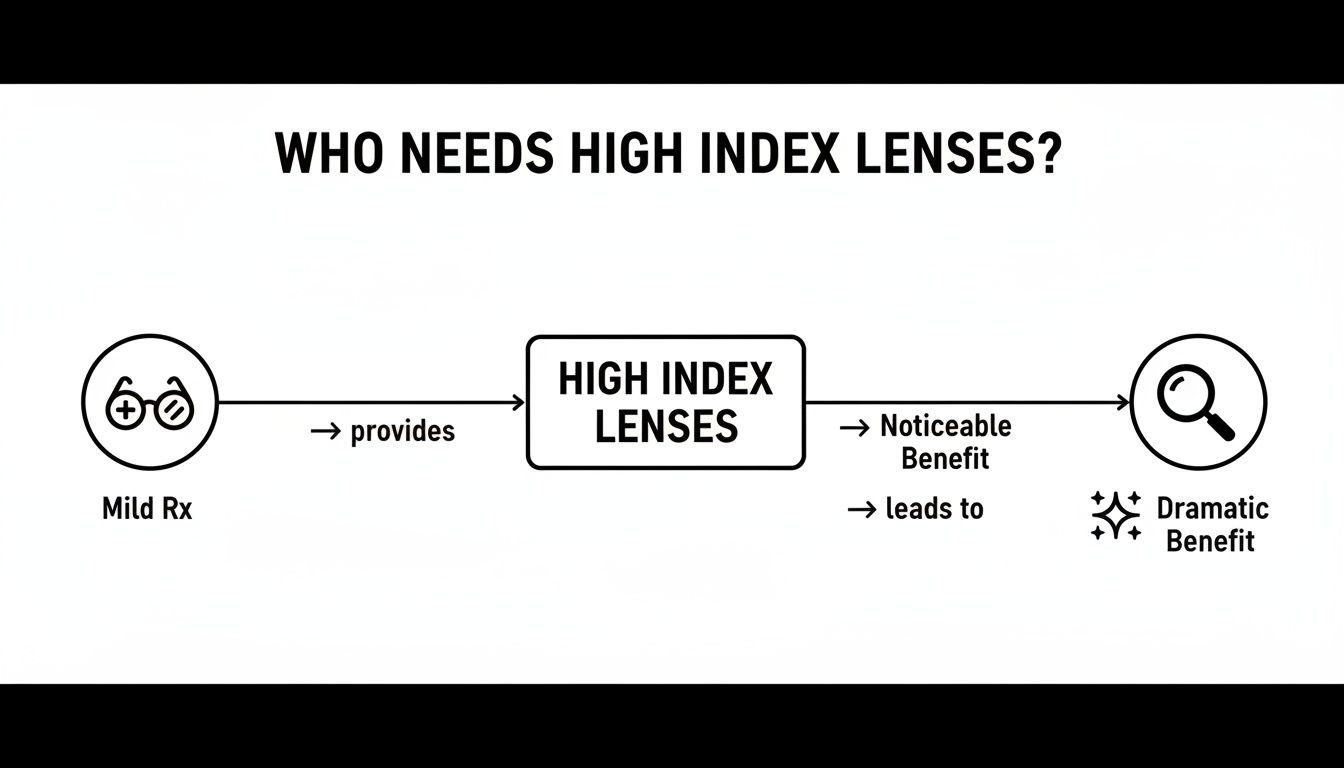
As you can see, the difference is noticeable even with milder prescriptions, but it becomes truly transformative for those who need more significant vision correction.
Ultimately, the best lens material comes down to what matters most to you. Are you an office professional with a -7.00 prescription who wants the thinnest, most elegant glasses possible? A 1.74 high-index lens is your answer. Are you a parent buying your active child their first pair of glasses? Trivex is the clear winner for safety and durability.
The demand for lenses that are both functional and fashionable is growing, with the global prescription lens market, where high-index lenses are a major player, reaching $36.99 billion in 2024. At Style Site Optical, our job is to help you sort through these options to find the perfect match for your vision, your look, and your life.
Essential Coatings to Maximize Lens Performance
Choosing a high-index material is a fantastic first step toward thinner, lighter glasses, but it’s only half the story. To truly get the best performance and protect your investment, lens coatings aren’t just a nice-to-have; they’re an absolute necessity. These microscopic layers are what transform a good lens into a great one, drastically improving clarity, durability, and comfort.
Think of it this way: you wouldn't buy a brand-new sports car and skip the high-performance tires or protective clear coat. The engine (the high-index material) provides the power, but the finishing touches are what make the experience truly exceptional. It's the same with your glasses.
This focus on premium optics is a growing trend. North America, which accounts for 34% of the global optical lens market, sees high-end materials like these making up a 25% slice of revenue. People are realizing that the right coatings are what unlock the full value of their eyewear.
The Non-Negotiable: Anti-Reflective Coating
If you remember one thing from this guide, make it this: anti-reflective (AR) coating is mandatory for high-index lenses. I simply can't stress this enough.
The very physics that allows high-index plastic to bend light so efficiently also causes it to reflect more light from its surface. Without an AR coating, you’re setting yourself up for constant visual distractions—annoying glare from office lights, distracting halos around oncoming headlights at night, and a mirror-like sheen on your lenses that keeps people from seeing your eyes.
An AR treatment solves all of this. It’s an incredibly thin, multi-layered coating that eliminates almost all surface reflections, allowing up to 99.5% of light to pass directly through to your eye. The difference is immediate and dramatic.
- Crisper, Higher-Contrast Vision: By removing the "visual noise" from glare, the world looks sharper and more defined.
- Reduced Eye Fatigue: Your eyes don't have to fight through reflections, which makes a huge difference during long days on the computer or when driving after dark.
- A Cleaner Look: Your lenses will seem to disappear, making for better eye contact and ensuring your glasses look pristine in photos and video calls.
We cover the different levels of AR technology in our complete guide on the best anti-reflective coating for glasses.
Essential Add-Ons for Durability and Protection
Beyond AR, a couple of other treatments are crucial for making sure your new glasses can handle the rigors of daily life.
A scratch-resistant coating is your first line of defense against everyday wear and tear. While modern high-index materials are quite tough, they aren't scratch-proof. A good hard coat acts as a protective shield, safeguarding your investment from the inevitable bumps, drops, and cleanings.
Just as important is UV protection. Most of us are diligent about putting sunscreen on our skin, but we often forget that our eyes need protection, too. While many high-index materials naturally block some UV light, you should always confirm your lenses provide 100% protection from UVA and UVB rays.
If you spend a lot of time in front of screens, a blue light filtering treatment can also be a game-changer for visual comfort, helping to ease the strain associated with digital device use. Other specialty options exist, of course, but it pays to research the pros and cons of photochromic lenses before deciding if they fit your specific needs.
Choosing the Right Frames for Thinner Lenses

So, you’ve decided on high index lenses—an excellent move for getting thinner, lighter glasses. But to really get that sleek, barely-there look, the frame you pick is just as crucial as the lens material itself. The right frame choice is what makes your new, slimmer lenses truly shine.
The main goal is to pick a frame that helps hide any remaining lens thickness at the edges. This is especially important for those with strong nearsighted prescriptions, where lenses are naturally thickest on the outside. Even a top-of-the-line 1.74 index lens will have some edge thickness with a high prescription, but a well-chosen frame can make it practically invisible.
Frame Styles That Flatter High Index Lenses
To make the most of your investment, some frame materials and shapes just work better with high index lenses. Think smaller, more centered, and a little more substantial.
Round and Oval Shapes: These are fantastic choices. Their shape allows the optical center of your lens to align nicely with the frame's center, which drastically cuts down on the thickest parts of the lens. It's a much better fit than wide, rectangular frames for stronger prescriptions.
Smaller Eye Sizes: It's simple geometry—a smaller frame opening means less lens material is visible. This is probably the single most effective trick for reducing both edge thickness and overall weight.
Plastic or Acetate Frames: A thicker plastic or acetate frame is your best friend for hiding lens edges. The frame’s own material provides a natural camouflage, neatly tucking away any part of the lens that might stick out.
This doesn't mean you have to abandon larger styles entirely, but knowing these principles helps you choose wisely. Our opticians are experts at helping you explore the different types of eyeglass frames we carry at Style Site Optical to find that perfect balance between your prescription and your personal style.
Understanding the Investment in Your Vision
It's no secret that high index lenses cost more than standard ones. That price difference isn't arbitrary; it’s a direct reflection of the sophisticated material science and intricate manufacturing needed to produce these advanced lenses.
Think of it like the materials used in high-performance sports cars versus a standard family sedan. The advanced polymers in high index lenses require incredibly precise engineering to bend light so efficiently, and that process demands a higher level of quality control.
Instead of seeing it as an extra cost, consider it an investment in your daily life. You're investing in:
- All-Day Comfort: Lighter glasses mean less pressure on your nose and ears. No more afternoon headaches or constant adjustments.
- A Confidence Boost: Thinner lenses eliminate the "coke bottle" look, giving you a more natural and flattering appearance.
- More Style Options: You suddenly have access to a much wider world of frames that might not have worked with your old, thicker lenses.
When you pair the right high index lenses with the perfect frame, you’re getting more than just glasses. You’re investing in superior comfort, vision, and a style you'll love putting on every single morning.
Answering Your High-Index Lens Questions
It's completely normal to have a few questions before trying a new type of lens. Let's walk through some of the most common ones we hear from our clients, so you can feel great about your decision.
Are High-Index Lenses More Fragile?
This is a frequent concern, but you can rest easy. While they aren't quite as shatter-proof as materials like polycarbonate or Trivex, modern high-index lenses are more than tough enough for daily life. They all come standard with a strong scratch-resistant coating to protect against the occasional drop or bump.
For kids or anyone with a particularly rough-and-tumble lifestyle, Trivex is often the safer bet. For most of us, though, high-index lenses deliver that perfect combination of a sophisticated, slim look and real-world durability.
Will My Vision Seem Different?
You'll see just as clearly! High-index lenses provide the exact same prescription power you're used to. That said, some people with very strong prescriptions might notice a slight "color fringing" effect (chromatic aberration) at the very edge of their peripheral vision when they first get them.
The good news? The vast majority of wearers adapt to this optical quirk almost immediately. The incredible difference in all-day comfort and appearance usually makes this minor trade-off more than worth it. A quality anti-reflective coating is also a huge help in delivering the crispest vision possible.
Why Is an Anti-Reflective Coating So Important?
The very thing that makes high-index lenses so thin—their dense, efficient material—also makes them naturally more reflective. Without a good anti-reflective (AR) coating, you'd notice a lot more distracting glare from overhead lights, halos around headlights when driving at night, and even reflections of your own eye on the lens.
An AR coating is non-negotiable for high-index. It works by canceling out those reflections, allowing more light to reach your eye for sharper, clearer vision. It also makes your lenses look practically invisible, so people can see your eyes without any distracting glare.
Can I Get High-Index Lenses as Progressives or Sunglasses?
Absolutely. High index lenses are incredibly versatile and can be crafted for nearly any vision need. We can make them as single-vision, bifocals, and, of course, custom digital progressives.
You also don't have to sacrifice style or function. We can tint them to any color for a custom pair of sunglasses or fit them with photochromic technology like Transitions®, which darken automatically when you step outside. You get all the benefits of a thinner, lighter lens without any compromise.
Have more general questions about eyewear? You might find the answer on our complete Style Site Optical FAQs page.
Ready to see and feel the difference for yourself? The expert team at Style Site Optical is here to guide you to the perfect lens and frame for your prescription, face, and lifestyle. Book your appointment today and discover just how great you can feel in your new glasses. https://stylesiteoptical.com

Medically reviewed by Dr. Teresita Bollar, OD, Optometrist at Style Site Optical, Aventura, FL.


