
Most sunglasses advice gets one thing backwards. It treats non-polarized lenses as the cheap compromise and polarized lenses as the upgrade everyone should want.
That's too simplistic. Polarization is a feature for a specific visual problem, mainly reflected glare. It isn't the core safety function of sunglasses, and it isn't automatically better for every person, task, or environment. If you spend a lot of time checking a phone, reading a dashboard, watching a bike computer, or relying on cockpit-style displays, non polarized sunglasses can be the smarter choice.
I'd explain it to a patient this way. Start with the job you need the lens to do. If your main issue is harsh glare bouncing off water, snow, or pavement, polarized lenses may help. If your priority is consistent vision, reliable screen visibility, and good everyday sun protection, non-polarized lenses often make more sense.
What Non Polarized Sunglasses Actually Are
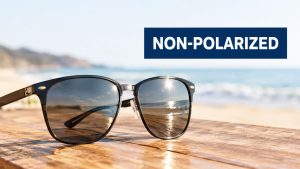
Non polarized sunglasses are tinted lenses that reduce overall brightness without using a polarization filter. They don't selectively block one plane of reflected light the way polarized lenses do. Instead, they dim incoming light more evenly across the visual field.
That sounds less advanced, but it isn't less legitimate. In fact, this is the older and more basic form of sunwear. Industry history places polarization as a later add-on, tracing back to Edwin H. Land's Polaroid invention in 1932, while non-polarized sunglasses remained the standard category for general light attenuation and fashion use before polarization became commercialized for glare control, as summarized by ANSI's overview of eyewear standards and history.
Safety standards focus on UV first
The first point that confuses buyers is this: polarization is not the main safety standard for sunglasses.
Major standards focus on ultraviolet protection and visible light transmission. The U.S. ANSI Z80.3-2025 standard covers noncorrective lenses used for light attenuation and fashion eyewear. Australia's mandatory standard requires protection from ultraviolet radiation in the 280 to 400 nanometre range, and ISO 12312-1:2022 treats lenses as providing 100% UV protection when transmittance up to 380 nm is below 0.05%. Canada also separates sunglasses into performance bands, including cosmetic lenses that block up to 60% of visible light and 87.5% to 95% of UVB, and general-purpose sunglasses that block 60% to 92% of visible light and 95% to 99% of UVB, according to this standards summary on sunglass performance.
If you remember one thing, remember this: UV protection is what protects eye tissue. Polarization mainly changes how glare looks.
Tint darkness and UV protection are not the same
A dark lens can still be a poor protective lens if it doesn't block UV properly. Visible light transmission, or VLT, tells you how much visible light passes through the lens. It tells you how dark the tint appears, not how safe the lens is from a UV standpoint.
Practical rule: Never assume a darker lens is safer. Look for UV labeling, not just a deep tint.
Consumers often do better when they start with UV labeling and then choose tint, fit, and lens behavior based on lifestyle. If you want a broader primer on what labels matter most, this guide to sunglasses for eye protection is a useful companion.
Why some people actually prefer them
Non polarized sunglasses often deliver a more predictable view. Colors tend to look consistent, and screens usually stay readable because the lens isn't trying to cancel a specific orientation of light. For daily wear, that matters more than many buyers expect.
Non Polarized vs Polarized Lenses Side by Side
Polarized lenses aren't better across the board. They're better at one thing in particular: cutting reflected glare from flat, shiny surfaces. That can be excellent near water, snow, or bright pavement. It can also create tradeoffs that patients notice only after they've bought the glasses.
One underserved point is visual performance under glare. A controlled study reported that polarized and non-polarized sunglasses did not significantly differ in visual acuity, stereopsis, or phoria under glare, with only small, non-significant contrast-sensitivity changes, according to the published glare comparison study. That doesn't mean polarization never helps. It means the usual consumer message of “polarized is always better” is too broad.
The real difference is selective filtering
Polarized lenses filter reflected light in a way that can make water, roads, and other reflective surfaces look calmer and less glaring. Non-polarized lenses don't do that selective filtering. They reduce brightness overall.
That difference affects more than comfort. It can affect what information you can see quickly and reliably.
| Feature | Non Polarized Sunglasses | Polarized Sunglasses |
|---|---|---|
| Glare control | Reduces overall brightness but doesn't target reflected glare | Better at cutting reflected glare from surfaces like water and pavement |
| Color view | Often feels more consistent across settings | Can change how reflective surfaces appear |
| Contrast under glare | Usually steady and predictable | May improve comfort in glare-heavy settings |
| Depth and spatial tasks | Research didn't show significant differences in visual acuity, stereopsis, or phoria under glare | Research didn't show significant differences in those same measures under glare |
| Screen compatibility | Usually works well with phones, dashboards, GPS, and bike computers | Can darken, distort, or black out some screens |
| Instrument reading | Often easier for gauges and displays | Can interfere with some digital readouts |
| Everyday use | Strong choice for commuting, city wear, and screen-heavy routines | Strong choice for glare-heavy recreation |
| Cost | Often simpler and more budget-flexible | Usually adds a specialty filter layer |
Screens are where the difference becomes obvious
Recent consumer guidance has emphasized a practical issue many people discover the hard way. Polarized lenses can darken or black out phone, dashboard, GPS, and bike-computer screens, while non-polarized lenses avoid that problem, as explained in this comparison of polarized and non-polarized sunglasses.
If you check a screen dozens of times a day, lens compatibility stops being a minor detail.
That's why people who drive often, cycle with digital computers, or work outdoors with handheld devices sometimes end up preferring non-polarized lenses even if they originally assumed polarized was the premium option.
For a side-by-side buying discussion focused on lens behavior rather than marketing labels, this overview of polarized lenses vs non-polarized is worth reading.
Lens Materials, Tints, and Coatings Worth Knowing
Once you stop treating polarization as the main decision, the lens itself becomes more interesting. Material, tint, and coating often shape day-to-day comfort more than buyers realize.
Lens material changes feel and durability
In practice, most non-polarized sunglasses are made in common ophthalmic materials such as polycarbonate, CR-39 plastic, Trivex, and glass. Each has a different personality.
- Polycarbonate is light and impact-resistant. It's a practical choice for active wear, kids, and people who want a durable everyday pair.
- CR-39 plastic usually offers clear optics at a reasonable price and works well for many prescription and non-prescription uses.
- Trivex balances low weight, impact resistance, and good optical quality.
- Glass resists scratching well and can look exceptionally crisp, but it's heavier and less forgiving if dropped.
Tint tells you brightness, not protection
Visible light transmission is the percentage of visible light that passes through the lens. Lower VLT means a darker lens. A standards-oriented explainer notes that UV protection is independent of tint and that buyers should look for UV400 or 99% to 100% UVA/UVB protection instead of assuming darkness means safety, as explained in this VLT guide and tint overview.
For outdoor sunwear, benchmark transmission ranges often cluster around 8% to 40% luminous transmittance. Category 3 lenses commonly transmit about 8% to 18% of visible light, while category 4 lenses transmit about 3% to 8%, according to this clinical review of spectacle lens tints and coatings.
Coatings can be more useful than polarization
Many patients get more benefit from a smart coating package than from polarization alone.
Consider these upgrades:
- Back-surface anti-reflective coating helps reduce light bouncing off the inner side of the lens into your eyes.
- Scratch-resistant hard coats help preserve clarity longer.
- Hydrophobic and oleophobic layers make lenses easier to clean and less likely to hold smudges.
- Mirror finishes can reduce incoming brightness and change cosmetic appearance, though they don't replace proper UV protection.
If you're comparing coating choices for prescription lenses, this guide on Transitions and anti-reflective coatings helps sort out what each add-on does.
Best Use Cases for Non Polarized Sunglasses
Non-polarized lenses stop looking like the fallback option. In several real-world settings, they're the more functional pick.
Driving and commuting
Drivers often assume polarization is always better because roads can be bright. Sometimes that's true. But many drivers care just as much about reading the instrument cluster, navigation screen, backup camera, and phone without strange dimming or black patches.
Non polarized sunglasses keep the visual scene more uniform. For people who move constantly between windshield view, mirrors, and digital displays, that consistency can be more useful than extra glare filtering.
Piloting and instrument-heavy work
Pilots, aviation staff, and anyone relying on LCD-style instrumentation often avoid polarization for a reason. A lens that cancels reflected light can also reduce the visibility of information you need to see.
That same logic applies on the ground. Cyclists checking a bike computer, delivery drivers using route screens, and technicians reading outdoor equipment displays often prefer non-polarized lenses because they don't interfere with screen readability.
Some jobs depend less on “maximum glare reduction” and more on “never hide important information.”
Water and high-reflection environments
This is the area where nuance matters most. If your main task is cutting surface glare to see more comfortably across open water, polarized lenses can be excellent. But not every water activity has the same visual goal.
If you're swimming, kayaking, or riding a jet ski, a more natural, less selectively filtered view may be preferable. In some settings, reflected light is useful information. It can help signal surface texture, changing conditions, or object boundaries.
| Activity | Non Polarized | Polarized | Notes |
|---|---|---|---|
| Daily driving | Recommended often | Sometimes useful | Choose based on glare level and screen dependence |
| City walking | Recommended often | Optional | Everyday brightness control may be enough |
| Cycling with a digital computer | Strong choice | Use caution | Display readability can matter more than glare reduction |
| Piloting or cockpit-style displays | Often preferred | Often less suitable | Screen and instrument visibility matter |
| Fishing or boating | Sometimes suitable | Often preferred | Reflected-water glare is the main issue |
| Swimming or jet-ski use | Often suitable | Depends on preference | Some users prefer a more direct, natural surface view |
| Outdoor work with handheld screens | Strong choice | Use caution | Avoid display dimming and darkening |
Screen-heavy lifestyles
A lot of modern life happens through displays. If your sunglasses make your devices harder to read, you won't keep wearing them. For many people, that single fact settles the decision.
Prescription Options, Safety, and Local Fitting Guidance
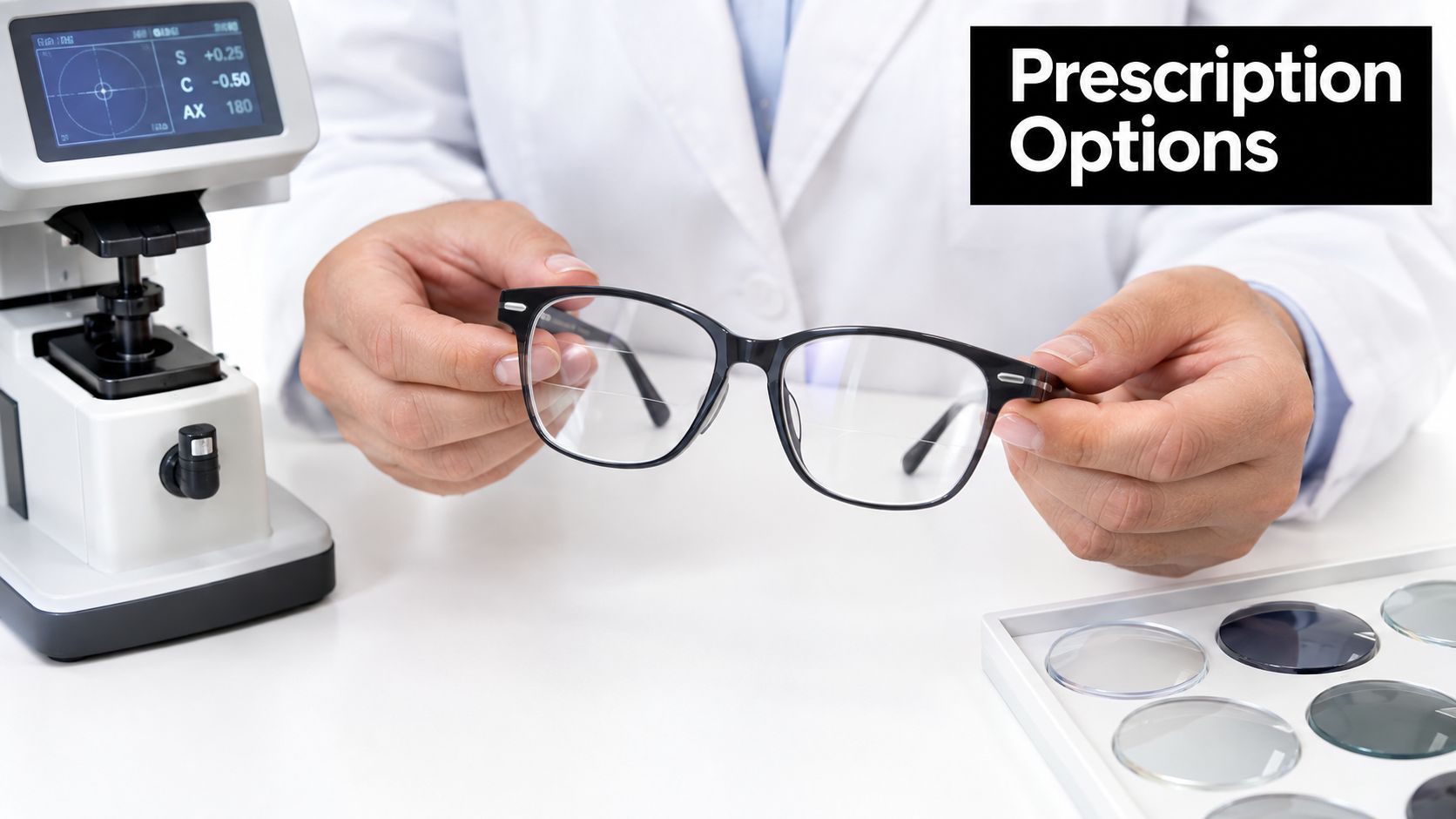
Prescription sunwear gives you more flexibility than many buyers expect. If you need vision correction, you can usually get non-polarized sunglass lenses in single-vision, bifocal, and progressive designs, depending on the frame and prescription.
Prescription lens choices
The lens materials used for prescription non-polarized sunglasses are often the same materials used in clear eyewear. Polycarbonate and Trivex are commonly chosen when impact resistance matters. CR-39 can be a good fit for straightforward prescriptions, and some wearers still prefer glass for its optical feel if weight isn't a concern.
Frame selection matters more than people think. A wrap frame may look great, but stronger prescriptions can behave differently in highly curved sunglasses. That's one reason an in-person fitting is helpful.
If you want a practical overview of available lens formats, this page on prescription sunglasses outlines the basic options.
Safety labels and impact questions
For general sunwear, UV labeling matters regardless of whether the lens is polarized. A non-polarized lens still needs proper ultraviolet protection. Polarization doesn't replace that requirement.
For patients asking about occupational or sports use, the conversation may also include impact considerations and whether a frame or lens is intended for general sunwear or for a safety-rated purpose. That's where a clinic can clarify whether your needs point toward fashion sunwear, prescription sunglasses, or dedicated protective eyewear.
What a fitting visit usually involves in South Florida
In Aventura, Miami, Hollywood, and North Miami Beach, patients often need sunglasses that can handle strong sun, daily driving, and time in and out of air-conditioned spaces. A proper fitting visit usually includes:
- Prescription verification if your current numbers have changed or your distance vision feels off.
- Pupillary measurements so the optical center sits where your eyes look.
- Frame fit checks for bridge width, temple length, and lens height.
- Lifestyle questions about screens, driving, boating, or work outdoors.
- Adjustment services after pickup so the glasses sit evenly and don't slide.
Insurance, FSA, and HSA details vary by plan, so patients should ask before ordering. Custom prescription sun lenses also take fabrication time, which depends on the lens design, tint, coatings, and frame choice. If you're shopping locally, providers such as Style Site Optical can walk through those variables during an exam and fitting rather than leaving you to guess from an online product page.
Care and Maintenance That Protects Your Lenses
Good lenses wear out early when people clean them the wrong way. The damage usually doesn't come from one dramatic mistake. It comes from small habits repeated every day.
The daily routine that actually works
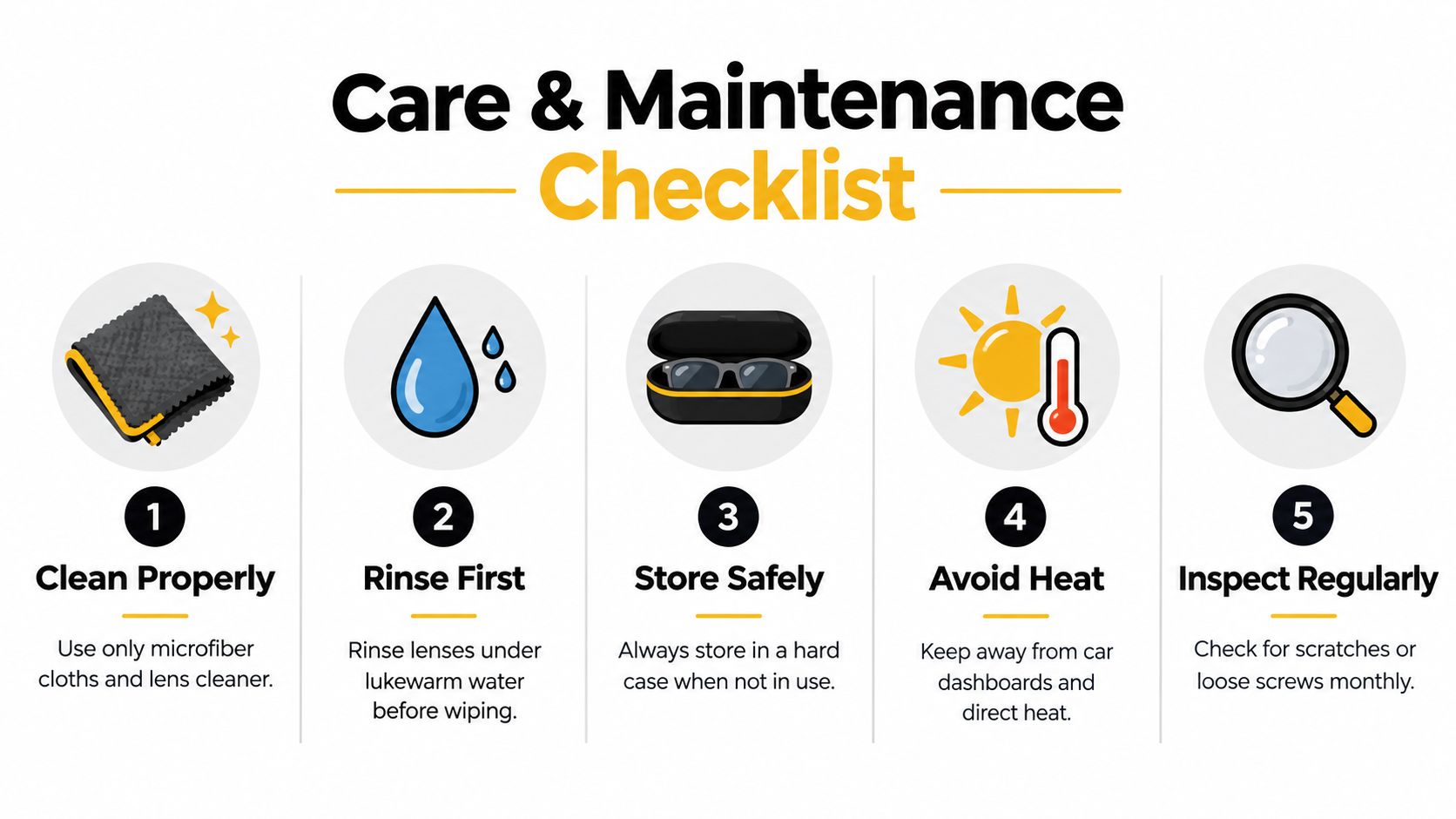
Start with a rinse. Dust, sand, and salt particles can scratch a lens if you grind them across the surface with a dry cloth.
Then follow a simple sequence:
- Rinse first. Use lukewarm water to remove grit.
- Apply lens cleaner. Use a cleaner intended for eyewear lenses.
- Dry with microfiber. Avoid shirt hems, tissues, and paper towels.
- Store in a case. A hard case protects both lenses and frame alignment.
“Clean lenses gently, but store them seriously.” Most scratching happens off the face, not on it.
If your lenses already have visible marks, this guide to scratch repair on glasses can help you tell the difference between a fixable smudge problem and a lens that should be replaced.
Heat, humidity, and coastal wear
South Florida adds a few extra challenges. Heat inside a parked car can warp frames and stress lens coatings. Salt air can leave residue on lenses and hardware, especially on metal frames.
A few habits help:
- Keep them off the dashboard. Heat exposure can shorten the life of coatings and distort some frames.
- Wipe away salt residue. If you've been near the ocean, rinse before storing.
- Check screws monthly. Humidity and regular wear can loosen hardware over time.
Know when replacement makes more sense
Some scratches are cosmetic. Others sit directly in your line of sight and reduce visual comfort. If a coating is peeling, crazing, or creating haze, patients often feel more relief replacing the lenses than trying to keep them going.
Choosing the Right Pair and Getting Expert Help
The simplest way to choose sunglasses is to ignore the “polarized versus non-polarized” debate at first and ask four better questions.
The four-point checklist
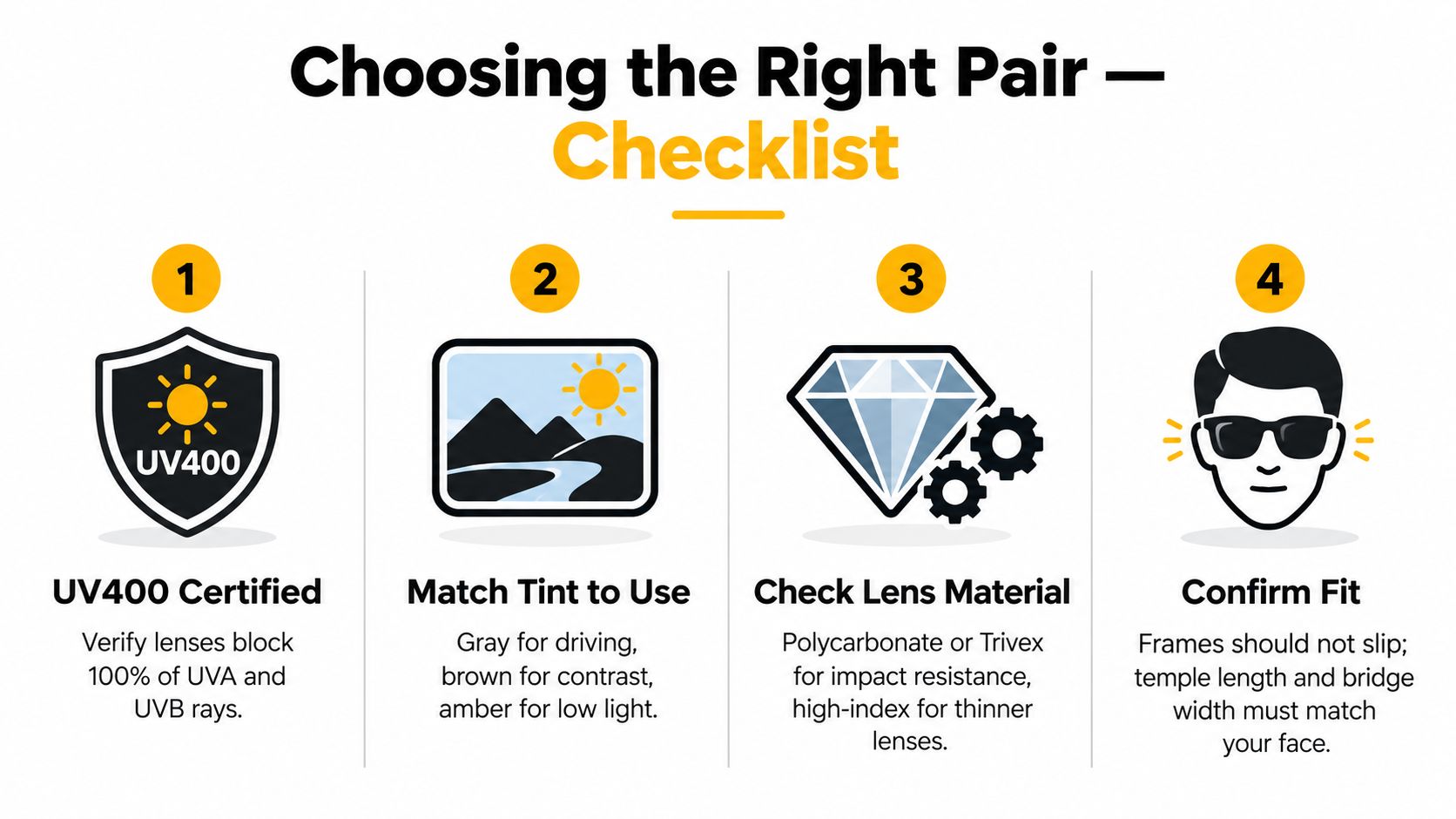
- Start with UV protection. If the lens doesn't provide proper UV protection, nothing else matters.
- Match tint to your environment. Daily city wear, beach use, and bright open-road driving don't always call for the same darkness.
- Choose the right material. Think about impact resistance, weight, and whether this is a backup pair or an all-day pair.
- Confirm fit. A frame that slips, pinches, or sits too close to your lashes won't get worn consistently.
When an optometrist should be involved
Some buyers can shop easily off the rack. Others shouldn't.
You should get professional input if you have:
- A prescription, especially a progressive or stronger correction
- Occupational needs involving screens, instruments, or outdoor work
- Post-surgical eyes or unusual light sensitivity
- Fit problems from a low bridge, narrow face, or wraparound frame preference
A good fitting doesn't just measure your prescription. It checks how the frame sits, where your pupils align within the lenses, and whether the finished sunglasses match the way you use them.
Here's a short video that helps visualize what to look for when evaluating sunglass options:
Questions worth asking at a fitting
Bring specific questions instead of asking, “What's best?”
Ask things like:
- Will this lens keep my dashboard and phone readable?
- Is this frame deep enough for my progressive design?
- How will this tint behave in bright Florida sun?
- Will the frame stay stable when I'm driving or walking outside?
That approach usually leads to better results. Non polarized sunglasses aren't the lesser choice. For many people, they're the more precise choice.
If you're comparing lens options in Aventura or the greater South Florida area, Style Site Optical provides eye exams, prescription sunglasses, frame fittings, and guidance on lens materials, tints, and coatings. If your daily life depends on clear screen visibility, reliable UV protection, and comfortable all-day wear, an in-person fitting can help you choose a non-polarized pair that matches how you live.