You take your glasses off to clean them, turn them under the light, and there it is. One scratch across the lens. Sometimes it’s a faint hairline mark. Sometimes it sits right where your eye wants to focus all day.
That moment is frustrating because glasses aren’t just an accessory. They’re something you rely on from the first look at your phone in the morning to the drive home at night. When a lens gets scratched, the problem isn’t only cosmetic. It can interrupt clarity, create glare, and make your eyes work harder than they should.
Patients often ask me the same question in different ways. Can this be buffed out? Is there a home fix? Do I really need new lenses? The honest answer is that scratch repair on glasses has definite limits, especially now that most prescription lenses carry multiple coatings that are easy to damage and hard to restore.
That Sinking Feeling When You See a Scratch
A scratched lens bothers people for a reason. Your eyes don’t just look through the scratch. They keep noticing it.
A tiny mark near the edge may be more annoying than harmful. A scratch near the center of the lens is different. It can scatter light, pull your attention away from what you’re looking at, and make normal tasks feel oddly tiring.
Why a scratch feels worse than it looks
Patients often describe the same pattern:
- Reading gets harder: Letters seem less crisp, especially on bright screens.
- Night driving feels messier: Headlights catch the damaged area and create distracting glare.
- The lens never looks clean: Even after wiping it, the lens still seems smeared.
- They start squinting without realizing it: Not because the prescription changed, but because the surface did.
That’s why I don’t treat lens scratches as a purely cosmetic issue. If your glasses are suddenly uncomfortable, the scratch may be part of the reason. In some cases, the right next step isn’t repair at all. It’s the same decision point people reach when they notice other signs you need new glasses.
The temptation of the quick fix
When a scratch shows up, many individuals do what anyone would do. They search for a fast answer.
They find toothpaste, baking soda, polish, wax, and videos promising an easy rescue. Those ideas are appealing because they sound cheap and immediate. The problem is that a lens surface is more complex than it looks.
Practical rule: If a method works by abrasion, it may reduce the visibility of a mark by removing material around it. That can also remove the parts of the lens you wanted to keep.
That trade-off matters most on prescription eyewear. A quick experiment on an old pair of cheap sunglasses is one thing. Trying the same method on the glasses you wear to drive, work, and read is another.
The safest approach starts with a simple question. Is this a light surface mark, or are the lens and its coatings compromised? That distinction changes everything.
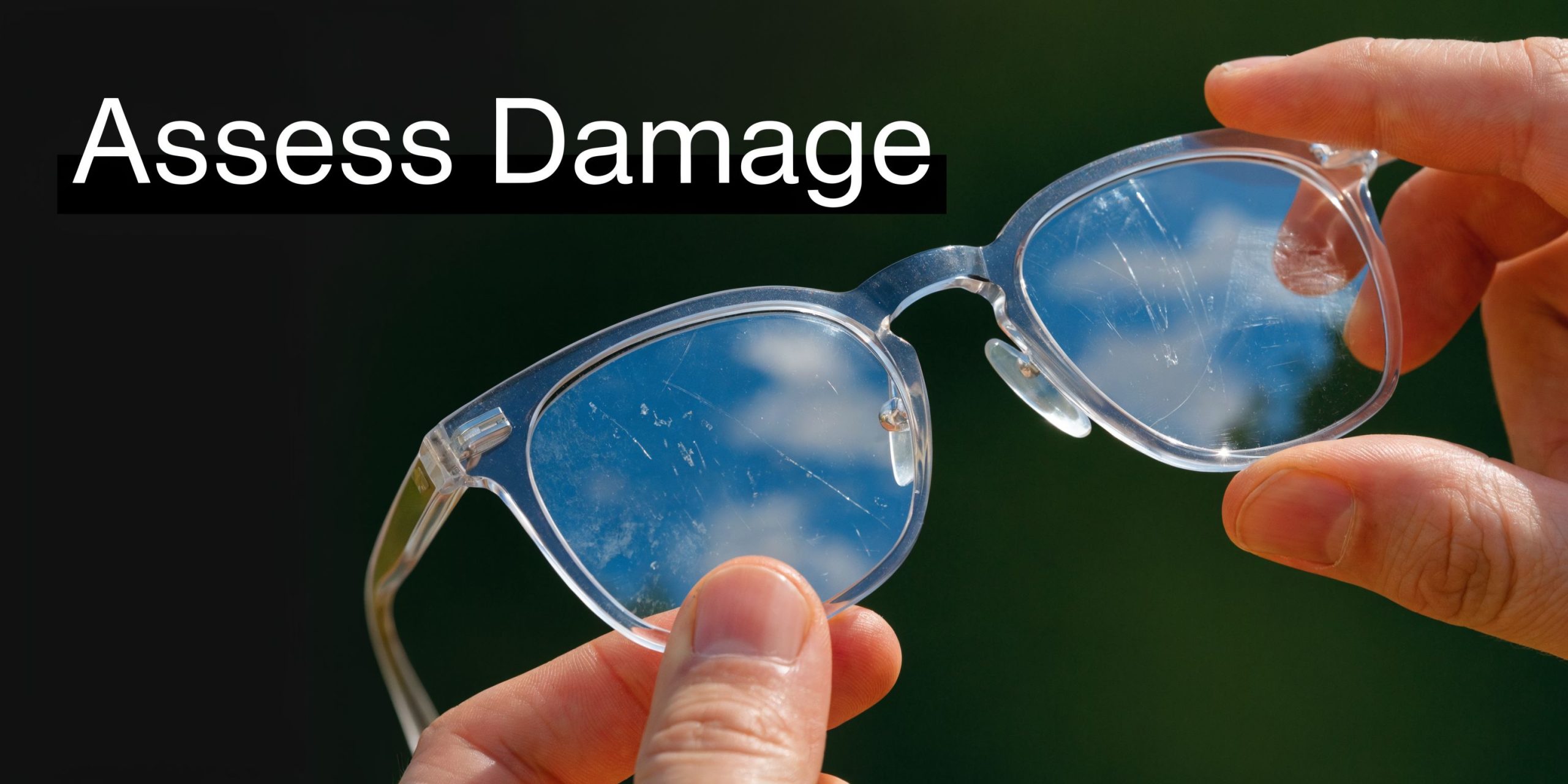
First Assess the Damage on Your Lenses
Before you try anything, slow down and inspect the lens properly. A lot of bad decisions happen because people treat every scratch as if it’s the same.
Start with a clean lens and good light
Rinse the lenses gently first so dust isn’t hiding the true condition. Then look at them under a bright light and tilt them slowly.
You’re trying to identify three different problems that people often confuse:
- A true scratch
- A smudge or residue
- Coating damage, which can look cloudy, patchy, or rainbow-like
That last category matters. The eyeglass repair industry has major limits here. Prescription glasses usually carry multiple protective coatings, and common household remedies like toothpaste or baking soda can damage those coatings instead of repairing the scratch, often leaving lenses cloudy and blurry, as noted in this discussion of can you get scratches out of eyeglasses.
Use the fingernail test carefully
A simple test helps.
Lightly run a fingernail across the mark.
- If your nail doesn’t catch, the scratch may be superficial.
- If your nail catches, it’s more likely a deeper gouge.
- If the area looks broad and hazy instead of sharply lined, think coating damage rather than a single scratch.
This doesn’t give you a diagnosis with perfect precision, but it helps sort out what’s practical. Deep damage rarely responds well to home polishing.
Modern lenses aren’t just one piece of plastic
Many patients still picture lenses as a simple clear surface. Most modern prescription lenses are much more layered than that.
A lens may include:
- Anti-reflective coating to reduce glare
- Scratch-resistant treatment to help with daily wear
- UV protection
- Blue light filtering, depending on the lens choice
- Hydrophobic or smudge-resistant layers that help moisture and oils slide off
Each of those layers affects comfort, clarity, or durability. Once you start rubbing the surface with an abrasive substance, you aren’t targeting only the scratch. You may be altering the lens system itself.
If you wear thinner materials, this matters even more. Patients comparing premium materials can get a better sense of how specialized modern lenses are by looking at high-index lenses, which are designed for thinner profiles but still depend heavily on coating quality.
What kind of scratch are you dealing with
A practical way to think about it is this:
| Lens condition | What it usually means | Best next step |
|---|---|---|
| Faint hairline mark off to the side | Minor surface issue | Monitor or ask an optician to inspect |
| Scratch you can see while wearing the glasses | Functional vision problem | Professional evaluation |
| Scratch your fingernail catches | Deeper damage | Replacement is usually the practical option |
| Hazy patch, peeling look, or blotchy glare | Coating failure | Professional evaluation, often replacement |
Later in the article, I’ll cover the narrow situation where cautious home polishing might reduce a very minor mark. But first, it helps to see how lens damage behaves in practice.
When the scratch changes how you use your glasses
Don’t judge the damage only by how it looks on the table. Judge it by what happens when you wear the glasses.
Ask yourself:
- Does your eye keep finding the scratch?
- Do lights flare more than they used to?
- Do you avoid wearing that pair now?
- Do headaches or eye fatigue show up sooner?
If the answer is yes to any of those, the lens is no longer doing its job well. At that point, the goal isn’t making the scratch less visible under a lamp. The goal is restoring dependable vision.
Unsafe DIY Fixes You Must Absolutely Avoid
Some home methods don’t just fail. They make the lens worse in a way that can’t be undone.
That’s the hard truth behind a lot of viral advice about scratch repair on glasses. The method may seem gentle because it uses a household item. The lens doesn’t care whether the abrasive came from a hardware store or a bathroom cabinet.

Toothpaste is not a lens treatment
Toothpaste remains one of the most common suggestions online. It’s also one of the easiest ways to create a larger problem.
Toothpaste often contains micro-abrasives and whitening agents. On a modern lens, that can strip the very coatings that improve comfort and clarity. You may end up with a lens that has slightly less visible scratching but much more haze and glare.
Baking soda is not harmless because it’s common
Baking soda gets framed as a “mild” fix. Mild for a kitchen use doesn’t mean safe for a coated prescription lens.
Optometry experts note that abrasive DIY methods like baking soda paste or toothpaste strip anti-reflective, hydrophobic, and UV-protective layers. This is especially risky for pediatric patients, and in humid South Florida conditions damaged coatings can trap moisture and increase the risk of fungal growth, as explained in this guide on how to fix scratched glasses.
Other hacks that create avoidable damage
A few come up repeatedly in clinic conversations:
- Car wax or furniture polish: These may hide a mark briefly by changing how light reflects off the surface. They don’t repair the lens.
- Glass etching products: These are far too aggressive for prescription eyewear.
- Paper towels and tissues: They seem soft, but they can drag fine grit across the lens.
- Shirt hems: Convenient, yes. Clean and safe, rarely.
A lens can look “improved” right after a DIY treatment and still be permanently compromised.
That’s what catches people off guard. They don’t always see the full damage until later, when the lens starts looking filmy in sunlight or harsh under headlights.
Why children’s glasses need extra caution
Parents are often under pressure to solve the problem fast. A child scratches a lens, school starts the next day, and a home remedy seems easier than waiting.
This is the group where I’m most cautious. Children depend on clear, stable optics. If you unevenly abrade the surface of a pediatric lens, the result can be more disruptive than an adult might expect. Even small visual distortions can affect comfort, reading, and willingness to keep the glasses on.
If a child gets a product in the eye while trying a home fix, that becomes a separate problem entirely. If that ever happens, basic first-aid guidance for a chemical burn to eye is far more urgent than the scratch itself.
What to stop using immediately
If you want a simple rule, avoid anything that was not made for coated eyewear.
That means stopping these experiments on prescription lenses:
- Whitening toothpaste
- Baking soda pastes
- Metal polish
- Wood or furniture polish
- Automotive compounds
- Window or household cleaners
A scratched lens is frustrating. A scratched lens plus destroyed anti-reflective coating is worse.
The inherent trade-off
DIY methods usually promise one of two things. Either they claim to remove the scratch, or they claim to disguise it. On modern prescription eyewear, both paths come with the same concern. You’re changing the lens surface in a way that isn’t controlled.
That’s why I tell patients to separate two questions.
First, “Can I do something to this lens at home?”
Second, “Will I still trust this pair on my face afterward?”
Those answers are not always the same.
A Cautious Approach to At-Home Polishing
There is one narrow situation where a home attempt may be reasonable. It’s not on the glasses you depend on for daily prescription use. It’s for a very minor superficial scratch on inexpensive plastic lenses, ideally on eyewear that isn’t critical.
That distinction matters.
If you still want to try a DIY approach, do it as a harm-reduction exercise, not as a genuine repair strategy. The best outcome is usually a slight reduction in visibility, not restoration. The typical outcome is usually a slight reduction in visibility, not restoration.
When a home attempt is even worth considering
A cautious trial makes sense only if all of these are true:
- The scratch is superficial: Your fingernail doesn’t catch.
- The lens is plastic: Not glass.
- The pair is low-stakes: Old sunglasses, backup readers, or a pair you can afford to lose.
- You understand the result may be worse: That risk is part of the decision.
For minor superficial scratches on plastic lenses, a baking soda paste has only an anecdotal 30 to 50 percent success rate for reducing visibility, while deeper scratches have a failure rate of over 80 percent, according to this review of whether you can you buff a scratch out of glasses. The same source notes that over-rubbing can delaminate anti-reflective coatings in 40 to 50 percent of attempts, and up to 65 percent of users report worsened distortion from excess pressure.
The least risky way to try it
If someone is going to do this anyway, I’d rather they do it carefully than aggressively.
Clean the lens first
Rinse with lukewarm water and use a microfiber cloth. Any grit left on the lens turns polishing into grinding.
Assess the mark again
If it catches your nail, stop. This is not a home-polish situation.
Mix a small paste
Use a thick, simple baking soda paste. Keep the amount small so you’re not tempted to keep working the area.
Apply very lightly
Use a soft cotton ball or microfiber applicator. Keep the motion gentle and brief.
Rinse completely
Remove all residue with cool water, then dry with a clean microfiber cloth.
Check under light
If it looks hazy, uneven, or more noticeable, stop. Repeating the process often multiplies the damage.
What usually goes wrong
The problem isn’t only the paste. It’s the human response to a disappointing result.
People don’t see enough improvement, so they press harder. They scrub longer. They repeat the cycle. That’s where lens surfaces get altered beyond the original defect.
A practical explainer on how to buff out scratches can help you understand the general polishing principle involved, but eyeglass lenses are much less forgiving than many coated hard surfaces. Prescription optics require uniformity, not just a smoother appearance.
Clinical advice: If the pair has anti-reflective treatment, blue-light filtering, premium coatings, or an important prescription, skip the experiment.
Why I don’t recommend this for prescription glasses
Even in the best-case scenario, a home method doesn’t recreate the original lens. It may only make a shallow mark less obvious.
That’s not good enough for eyewear you rely on for work, driving, school, or all-day comfort. Once the lens surface becomes uneven or the coating is altered, clarity suffers in ways patients often notice more than they expected. The core problem is compromised optics.
If you’re comparing lens options because glare bothers you already, this is also why coating quality matters so much. A good overview of the best anti-reflective coating for glasses shows why those surface treatments are valuable and why preserving them matters.
The Professional Path to Guaranteed Clear Vision
Most patients assume professional help means a full new pair of glasses. Often it doesn’t.
For scratch repair on glasses, the professional route usually comes down to one practical question. Can this lens be left alone, or is replacement the better answer? In many cases, replacement is the cleaner, safer, and more economical decision.
Why professionals rarely promise scratch removal
An optician or optometrist may inspect the lens and confirm what type of damage you’re seeing. That alone is useful, because scratches, coating failure, and residue can look similar to the untrained eye.
Actual buffing is limited. Even in professional hands, it’s reserved for very minor cosmetic issues on certain lens types. Once a scratch affects optics or coatings, buffing has the same core problem as DIY. It changes the surface.
That’s why lens replacement remains the standard recommendation when vision quality matters.

Lens replacement is often more affordable than people think
Often, individuals wait too long because they assume replacement lenses will cost almost as much as a full new pair. That isn’t always true.
Lens replacement is the only 100% effective fix for scratches, and many consumers don’t realize optometrist-led replacement services often average $50 to $150, with post-2025 supply chain stabilization reported to have lowered high-index lens costs by 15%, according to this overview of how to remove scratches from sunglasses.
If you love your current frame, this matters. Keeping the frame and replacing only the lenses can be the most sensible path.
DIY versus professional care
| Option | What you may gain | What you risk |
|---|---|---|
| Home abrasion method | Slight reduction in a tiny surface mark | Haze, coating loss, distortion |
| Ignore the scratch | No immediate cost | Ongoing visual annoyance, glare, eye strain |
| Professional inspection | Clear diagnosis | Minimal downside |
| Lens replacement | Restored optics and coatings | Upfront cost, but predictable result |
Why local optical care still matters
Online ordering can be convenient, but lens quality control is not uniform. A 2021 Consumer Reports study found that about 10 percent of glasses ordered online failed to meet industry standards for prescription quality and impact resistance, according to Consumer Reports’ advice on buying eyeglasses frames lenses and coatings.
When a patient is already replacing scratched lenses, this is not the time to add another variable. You want the prescription verified, the fit checked, and the coatings matched to how you use the glasses.
What a professional replacement visit usually involves
The process is usually straightforward:
- Frame inspection: The optical team checks whether your existing frame is in good condition and worth re-lensing.
- Prescription review: If vision has changed, a new refraction may be appropriate.
- Lens selection: Here you choose material, anti-reflective treatment, scratch resistance, UV options, and any specialty features.
- Fit and alignment: Once the new lenses are in, the frame is adjusted so the optics sit where they should.
If your current pair is loose, bent, or uncomfortable in addition to being scratched, it helps to ask about eye glass repairs and adjustments at the same time.
Replacing a damaged lens is often less about “repair” and more about restoring the optical system you paid for in the first place.
A practical decision rule
If the scratch is visible while you’re wearing the glasses, or if the lens looks cloudy after any attempted fix, stop thinking in terms of polishing. Start thinking in terms of restoring function.
That shift saves time. It also saves many patients from spending days trying to rescue a lens that was never going to perform properly again.
How to Prevent Future Scratches on Your Glasses
Prevention is much cheaper than replacing lenses, and it doesn’t require anything complicated. Most scratches come from ordinary habits, not dramatic accidents.

Daily habits that protect lens surfaces
- Use a hard case: Not a loose pocket, not the car seat, not the bottom of a tote bag.
- Set glasses down with lenses facing up: This one habit prevents a surprising amount of damage.
- Clean with microfiber only: A shirt or paper napkin can drag fine debris across the lens.
- Rinse before wiping: Dry rubbing is where hidden grit does the most harm.
- Use lens-safe spray: Household cleaners can shorten the life of coatings.
Handling often matters more than expected
Take your glasses off with both hands when possible. That helps keep the frame aligned and reduces the odds of drops.
Don’t toss them onto a nightstand. Don’t leave them unprotected in a cup holder. Don’t store them where keys, sand, makeup residue, or coins can rub against the lenses.
Buy coatings with practical expectations
Scratch-resistant coatings are worth having, but they are not scratch-proof. They improve durability. They do not make a lens invincible.
That same mindset shows up in other protective industries. If you’re curious how surface protection has advanced elsewhere, this overview of self-healing technology in protective films is a useful reminder that some materials can recover from minor surface marks, but standard eyeglass lenses still require careful handling.
A short checklist to remember
| Situation | Better choice |
|---|---|
| Cleaning on the go | Carry a microfiber cloth |
| Storing glasses in a bag | Use a hard case |
| Quick wipe on a dusty lens | Rinse first, then wipe |
| Leaving glasses on a table | Put lenses facing up |
| Outdoor, sports, beach use | Keep a backup pair or protective case nearby |
Good habits won’t eliminate wear forever. They do give your lenses a much better chance of staying clear and comfortable for longer.
Frequently Asked Questions About Eyeglass Scratches
Can scratched glasses cause symptoms even if the scratch looks small
Yes. A small scratch in the wrong location can create glare, distraction, and visual fatigue that feels out of proportion to how minor it looks.
Is DIY scratch repair on glasses ever safe for children’s eyewear
I don’t recommend experimenting on a child’s prescription lenses. Children need stable, clear optics, and once a coating is damaged or the surface becomes uneven, the lens may become less comfortable and less reliable.
Is ordering replacement lenses online a good idea
It can be tempting, but quality control matters. A 2021 Consumer Reports study found that approximately 10 percent of glasses ordered online failed to meet industry standards for prescription quality and impact resistance, which is why professional verification still matters when safety and accuracy are priorities.
Are anti-scratch coatings worth it
Yes, with one caveat. They help resist day-to-day wear, but they don’t prevent all scratches. Think of them as added durability, not permanent protection.
Should I replace the whole pair or just the lenses
If the frame fits well and is in good condition, lens-only replacement is often the smarter move. If the frame is worn out, bent, or no longer works for your prescription needs, replacing the whole pair may make more sense.
How do I know when to stop trying home remedies
Stop as soon as the lens looks hazy, glare increases, or the scratch remains visible in your line of sight. At that point, more rubbing usually means more damage.
If your glasses are scratched and you want a clear answer before making things worse, schedule a visit with Style Site Optical. Dr. Bollar and the team help patients in Aventura, Miami, Hollywood, and North Miami Beach evaluate scratched lenses, protect prescription accuracy, and choose the most practical next step for clear, comfortable vision.